

At over 11,000 words and 100 citations, this post is a little longer than my typical work but it is my best telling of what happened with Anthropic and the Department of War (DoW). I began working on it during the last couple weeks of February, but the bulk of it written in April and early May 2026, so some items might be out of date soon.
Also, I filed comments with the FTC and the DOJ, arguing for an AI safety safe harbor. (My tweet can be found here.) Last summer, OpenAI and Anthropic ran a joint safety evaluation but antitrust law makes deeper collaboration legally risky. At the end of the filing is a draft proposal that sets out the terms for structured safety collaboration while keeping prices, customers, and commercialization off the table.
The Dawn Raid
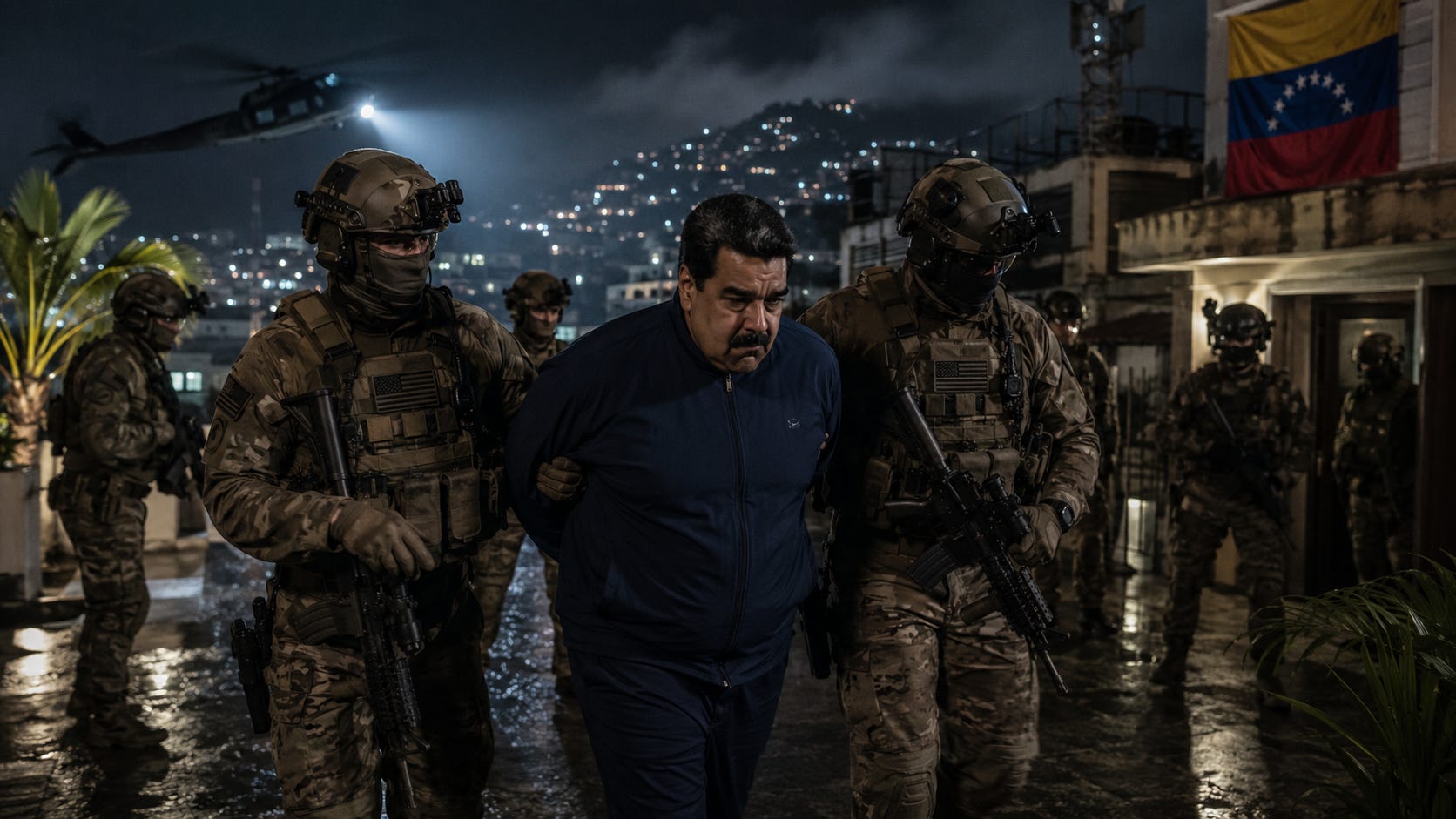
Before dawn on January 3, Caracas was jolted awake by the sounds of war. Explosions rippled across the Venezuelan capital. Residents reported low-flying aircraft, smoke near key military and transport sites, and neighborhoods swallowed by darkness as power failed across large parts of the city. By morning, the Trump Administration was claiming an extraordinary prize: Nicolás Maduro and his wife, Cilia Flores, had been seized.
At 4 AM ET, President Donald Trump announced the raid and added a flourish: “It was dark, the lights of Caracas were largely turned off due to a certain expertise that we have, it was dark, and it was deadly.”1
Joint Chiefs of Staff General Dan Caine then offered a more precise account: “The word integration does not explain the sheer complexity of such a mission, an extraction so precise it involved more than 150 aircraft launching across the Western Hemisphere in close coordination, all coming together in time and place to layer effects for a single purpose, to get an interdiction force into downtown Caracas while maintaining the element of tactical surprise.”2
But the statements from Trump and Caine were specific enough that anyone at Anthropic paying attention would have had good reason to ask whether their technology had been part of the operation, and if so, how it had been used.
On January 9th, the Department of War (DoW) moved to secure this tech in a memo that directed “the Under Secretary of War for Acquisition and Sustainment to incorporate standard ‘any lawful use’ language into any DoW contract through which AI services are procured within 180 days.”3 That memo formally opened renegotiation with Anthropic. By February, negotiations had broken down. Then Secretary Pete Hegseth gave Anthropic an ultimatum. Accept our terms, or face contract cancellation, a supply chain risk designation, or compelled cooperation under the Defense Production Act.
Eventually Anthropic was labeled a supply chain risk. The event was unprecedented. It was the first American company ever slapped with that mark, which was meant to apply to foreign adversaries.
The Pentagon needs the best tools it can acquire to fight wars and keep Americans safe. That is especially true now, as artificial intelligence is integrated and foundational to defense systems in Iran. But assembling this history has made clear that the Department’s process had serious procedural and strategic failures, even if its underlying concerns were fundamentally legitimate.
To take just one example, the memo gave the DoW 180 days to renegotiate the contracts but Anthropic was designated a risk in merely 53 days. DoW leadership chided Anthropic for being woke, which is a valid criticism in some ways, but then got rid of testing and evaluation requirements that could have uncovered these biases. The timing only made the move look more contradictory. The day after the ultimatum, the Iran operation began, and it depended heavily on Anthropic’s technology. And now, the White House is trying to figure out ways to get Anthropic back into government.4
The Anthropic-DoW fight touches on many aspects of AI, but the account I have assembled focuses on three core tensions:
State sovereignty over AI tech — The fight is not just about wokeness or contract fine print even though those things do matter. Instead, the Pentagon’s position is that lawful military use should be determined by the state, not by the internal values or usage policies of a private company. That’s a fine and reasonable first step. But the DoW cannot take a second step by retaliating against a company that refuses the new deal. It’s the second move that turns a procurement dispute into a deeper fight over sovereignty, authority, and the proper limits of private discretion in national security.
Paper authority versus state capacity — Vendor limits are not necessarily good in themselves, but stripping them away does not magically create government competence. The Pentagon treated contractual freedom as a substitute for technical understanding. It wanted broader rights with less testing and fewer constraints, all while rejecting the opportunity to build in-house expertise through joint R&D and evaluation. This feels like a self-inflicted wound. In the name of control, it passed up the chance to learn.
The DC–SF political divide — The Pentagon speaks in the language of command, law, sovereignty, and mission. Anthropic speaks in the language of alignment, evals, misuse, and technical uncertainty. Each side interprets the other’s vocabulary as bad faith. That cultural divide helps explain why the dispute became so emotionally charged.
The Maduro raid did not create those tensions, but it made them impossible to ignore.
To understand why this dispute escalated so quickly, it helps to go back to the relationship that existed before the raid, the terms both sides had accepted, and the assumptions that began to unravel once AI proved its value in combat.
The Lead Up
The Maduro raid didn’t create the rift between Anthropic and the Pentagon. It detonated one that had been building since August 2025, when Emil Michael took over as Under Secretary of War. The first thing he did was begin reviewing the AI contracts he’d inherited.
Ryan Hassan, Blake Dodge, and Harris Sockel reported on this moment of discovery in Pirate Wires:
To catch up on the department’s AI affairs, he familiarized himself with the contract language of Anthropic and other AI companies. Ultimately, he came to feel that the Biden people who signed the initial Anthropic deals — much like that president, he told us — were “asleep at the wheel.”
“I was like, ‘Holy cow,’” Michael said. “There’s 25 pages of terms and conditions of things I can’t do.”
Among the prohibitions: using Anthropic’s AI to plan kinetic strikes, which are military attacks using physical force like missiles or bombs, generally considered a central activity of war. For example, it’s pretty common for a war-fighter to hypothetically “plan” a kinetic strike. Nonetheless, using Claude to do so would violate Anthropic’s “terms of the service,” he said.
“This is a contract that should be made with GEICO Insurance, not with the Department of War,” he added.5
In December 2025, these discussions boiled over.
As Semafor was later to report, Under Secretary “Michael was outraged by Anthropic CEO Dario Amodei’s answer to a hypothetical question: If the US were under attack - with hypersonic missiles hurtling toward US soil - and Anthropic’s AI models could thwart the missiles, would the company refuse to help its country due to Anthropic’s prohibition on using its tech in conjunction with autonomous weapons?”6
According to people familiar with the conversation, Amodei said the Pentagon should contact Anthropic to seek approval. To Michael and others at the Department of War, that answer was intolerable. It suggested that in the middle of a national emergency, the military might still be required to pause and ask a private company for permission before using a system on which lives could depend and which could take lives.
Anthropic disputes that characterization, saying the company was willing to create a carveout for missile defense even if it otherwise barred certain weapons-related uses.7 What Anthropic saw as a safety-conscious effort to preserve case-by-case judgment, Pentagon officials saw as proof that the existing arrangement left too much discretion in the hands of a vendor at the very moment the government believed it needed unquestioned operational freedom.
For obvious reasons, the contract at the center of this controversy isn’t public, so it is difficult to understand exactly what the details spell out. Still, it is hard to believe that the Pentagon wantonly accepted a deal that they didn’t properly scope. Earlier approvals likely reflected a narrower bargain. The government wanted access to Claude for defense and intelligence uses, which Anthropic was willing to provide, subject to a set of especially sensitive uses.
We do know, according to court documents, that there are at least two distinct layers of the contractual relationship: “The Department accessed Claude through a contract with Palantir Technologies (which in turn partnered with Anthropic), as well as a separate agreement with Anthropic.”8
The first entanglement began in early 2024 when Anthropic partnered with Palantir “to support deployment of Anthropic’s commercial AI models in classified cloud environments.”9 In late 2024, Palantir announced that Claude had been integrated in their Artificial Intelligence Platform (AIP) “to support government operations such as processing vast amounts of complex data rapidly, elevating data driven insights, identifying patterns and trends more effectively, streamlining document review and preparation, and helping U.S. officials to make more informed decisions in time-sensitive situations while preserving their decision-making authorities.”10 This meant that Claude would be used within “an integrated suite of technology, facilitated by Amazon SageMaker, an accredited fully managed service, and hosted on Palantir’s Impact Level 6 (IL6) accredited environment,” which is the highest level of certification for cloud services, allowing users to store and process classified information up to the secret level.
That integrated suite of technology is known as Maven Smart System, which was developed under Project Maven. Started in 2017 as the Algorithmic Warfare Cross-Functional Team, the project was originally developed by Google as a way of applying computer vision to drone surveillance footage.11 But when the project was made public, Google faced backlash. Over 4,000 employees signed a petition against the project and 12 resigned in protest. So when the contract renewal came up, Google declined to continue.
Palantir stepped into the vacuum to take over, which has since evolved from a computer vision experiment into the foundational system on which all other DoD AI solutions for combat and intelligence will be built. The system now has over 20,000 active users across every combatant command. NATO even adopted Maven in April 2025.12 And as of March 2026, it is being formalized as a full program of record, making Project Maven a core asset for the military.13
(For a more thorough treatment of Project Maven, check out Katrina Manson’s “Project Maven: A Marine Colonel, His Team, and the Dawn of AI Warfare,” the definitive history of the project.)
In early 2025, Anthropic began working on a suite of dedicated models especially tailored for national security contexts.14 By March, Claude Gov was available to the intelligence community (IC) and to the DoW. In June 2025, an updated version of Claude Gov was deployed, which was accompanied by a public release from the company detailing the models.15 As they made clear, these models allowed for improved handling of classified materials, stronger understanding of intelligence and defense documents, greater proficiency in languages and dialects relevant to national-security operations, and improved capacity to interpret complex cybersecurity data for intelligence analysis.
Court documents would later confirm that,
DoW customers conducted extensive testing to confirm that the new model performed as expected before the prior version was retired and replaced. Anthropic closely collaborated with its government and third-party partners to ensure a seamless transition throughout this process. Within weeks of the November 2025 release, nearly all IC and DoW customers had adopted the updated version of Claude Gov. Government users praised this model as a major technical advance, citing significant improvements in reasoning, agentic tool use, and coding. These improvements enabled customers to fully leverage air-gapped deployment of Claude Code, Anthropic’s agentic coding tool, which is now widely used across the IC and DoW.16
To be clear, Anthropic is not the only model that has been authorized to work in these kinds of secure environments. Azure OpenAI got formal IL6 authorization in April 2025, and Google later said Gemini models were available at IL6.1718 But Anthropic was generally considered the best.
A second, distinct contractual layer of the relationship came about on July 14, 2025 when Anthropic announced a two-year prototype Other Transaction Agreement (OTA) contract with a ceiling of $200 million.19 Prototype OTAs are a familiar mechanism for bringing emerging technologies into government quickly without forcing them into the full machinery of traditional procurement. Importantly, Anthropic wasn’t the only company that the DoW’s Chief Digital and Artificial Intelligence Office (CDAO) had partnered with. Google, OpenAI, and xAI also signed similar agreements to bring their tech into “the Advancing Analytics (Advana) platform, Maven Smart System, and Edge Data Mesh nodes.”20
While the terms of the $200 million OTA have not been made public, George Washington Law Professor Jessica Tillipman pointed out that, “the terms are whatever the parties negotiate. An agency can use this flexibility to secure broad usage rights. A contractor can use it to embed restrictions. Either way, the terms are a product of negotiation, not a regulatory default.”21 Tillipman is a specialist in procurement law and explained in the post that, “The idea that a contractor categorically cannot restrict government use of its products, or that doing so is somehow illegitimate, reflects a fundamental misunderstanding of how government procurement law works. The scope of restrictions is determined by the specific acquisition pathway and what the parties negotiate. None of this is novel or controversial. It is basic procurement law.”
There are a lot of benefits to OTAs, but there are drawbacks as well, as this spat showed. OTAs are exempt from a number of statutory requirements, which can be burdensome, but they cannot be easily modified in the way that contracts obtained through Federal Acquisition Regulations (FAR) or Defense FAR Supplement (DFARS) can. As government contracts attorneys Cy Alba IV and Josie Farinelli explained, “Termination isn’t as simple as the government’s convenience and the contractor’s default under an [OTA]. Contractors have a chance to meaningfully negotiate the terms of the [OTA]’s termination with the government and, where possible, may even be able to impose conditions on the government’s ability to terminate the [OTA] (i.e., effectively eliminating the possibility of a termination for convenience).”22
To me, this feature of OTAs is little appreciated in this fight. OTAs aren’t subject to the Contracts Disputes Act (CDA) and the government doesn’t have the ability to easily exit these kinds of contracts. But that’s the deal that was struck. OTAs exist outside the standard DFARS framework, giving the Pentagon a faster path to prototype and acquire technology from the startup community.
OTAs are a fairly recent development. DARPA (Defense Advanced Research Projects Agency) got agency-wide authority in the 1980s.23 And it’s the marriage of OTA and the unique structure of the agency that is widely credited with its success. In 2016, Congress made OTA authority permanent and extended it over the entire DoW. The Army has been leading its use, which grew from $1.56B in FY 2016 to $18.36B in FY 2024.24
Because OTA terms are negotiated, the restrictions Anthropic embedded were ones the Pentagon agreed to. Anthropic’s own July 2025 announcement emphasized “prototype” work, “responsible AI deployment,” and “strict usage policies,” not unrestricted operational authority.25 That is entirely consistent with DoW officials later discovering the limits embedded in the arrangement signed during the Trump Administration.
Anthropic’s archived usage policies around this time suggest that it was willing to participate in national-security work given that there were meaningful boundaries.26 This included prohibitions on other categories of use, including disinformation campaigns, weapons design or use, censorship, domestic surveillance, and malicious cyber operations. Those restrictions appear to have been precisely the sort of terms that later infuriated Emil Michael and others inside the Pentagon.
Additionally, before the later breakdown in negotiations became public, Anthropic had reportedly bid on defense work connected to a Defense Innovation Unit for a $100 million prize challenge to prototype market-ready systems for coordinating autonomous platforms at the fleet level.27 While Anthropic didn’t win that award, it further undercuts the idea that Anthropic was categorically unwilling to engage in military applications.
But the 2025 OTA was struck at a time when the Executive was undergoing fundamental change. Less than a week after the prototype OTA became public, the Executive Order on Woke AI was adopted, reshaping how AI was to be adopted by government agencies.28 It is important to line up all the events because the contract at the center of the current controversy was not simply a Biden-era inheritance, even though it began during that administration. Rather, the entire procurement environment under the Trump administration was being renegotiated. It created the political backdrop aligning federal AI policy with efforts to de-woke the government.
The Inciting Event
The Maduro raid fundamentally changed the government’s relationship with artificial intelligence because it was a clear demonstration of coordinated decision advantage through AI. By fusing sensor inputs, intelligence, and operational data, AI helped to drive a platform that could synchronize cyber, space, electromagnetic, and conventional effects in real time.
Recently, the Pentagon’s Chief Digital and Artificial Intelligence Officer, Cameron Stanley, offered a peek into this platform, and explained how AI enables workflow integration and kill-chain compression.29 As Stanley stressed, AI is proving the Third Offset strategy.30
The idea of an offset comes from the Cold War, when the United States sought technological advantages that could compensate for an opponent’s larger conventional forces. The first offset was nuclear weapons. The second was the combination of stealth and precision-guided munitions. The third, in Stanley’s telling, is AI-enabled decision advantage.
Early military thinking often imagined AI as something embedded within the individual soldier. But what is actually being deployed by Project Maven is much broader. AI is the connective tissue that coordinates disparate sources of information and speeds up how military decisions are made. In Stanley’s telling, an analyst can move from detection, to workflow, to course-of-action generation, to action all inside one system. What once took hours across disconnected systems can now be done far more quickly.
After the raid, the Administration moved to lock in this capability. Just days later, the DoW circulated the “Accelerating America’s Military AI Dominance” memo meant “to unlock critical foundational enablers needed to accelerate war-winning efforts across the Department.”31 To be fair, a number of the organizational changes and new AI tech had been in the works for some time.32 But it was the last paragraph of changes that brought Anthropic and the DoW directly into conflict. It read:
Clarifying “Responsible Al” at the DoW - Out with Utopian Idealism, In with Hard-Nosed Realism. Diversity, Equity, and Inclusion and social ideology have no place in the DoW, so we must not employ AI models which incorporate ideological “tuning” that interferes with their ability to provide objectively truthful responses to user prompts. The Department must also utilize models free from usage policy constraints that may limit lawful military applications. Therefore, I direct the CDAO to establish benchmarks for model objectivity as a primary procurement criterion within 90 days, and I direct the Under Secretary of War for Acquisition and Sustainment to incorporate standard “any lawful use” language into any DoW contract through which AI services are procured within 180 days. I also direct the CDAO to ensure all existing AI policy guidance at the Department aligns with the directives laid out in this memorandum.
Three days later, Hegseth explained the new direction in a speech at SpaceX’s Starbase facility alongside Elon Musk.33 This was, of course, the same Elon Musk who signed an open letter calling for a ban on autonomous weapons in 2015.34 As the Secretary explained:
We’re executing an AI acceleration strategy that will extend our lead in military AI established during President Trump’s first term. This strategy will unleash experimentation, eliminate bureaucratic barriers, focus on investments and demonstrate the execution approach needed to ensure we lead in military AI and that it grows more dominant into the future…
Barriers to data sharing, authority to operate, or ATOs, test and evaluation and contracting are now treated as operational risks, not simply bureaucratic inconveniences. We are blowing up these barriers.
Hegseth also directly confronted Anthropic in the speech, saying,
Today I want to clarify what responsible AI means at the Department of War. Gone are the days of equitable AI and other DEI and social justice infusions that constrain and confuse our employment of this technology. Effective immediately, responsible AI at the War Department means objectively truthful AI capabilities employed securely and within the laws governing the activities of the department. We will not employ AI models that won’t allow you to fight wars.
We will judge AI models on this standard alone; factually accurate, mission relevant, without ideological constraints that limit lawful military applications. Department of War AI will not be woke. It will work for us. We’re building war ready weapons and systems, not chatbots for an Ivy League faculty lounge.22
We now know the context surrounding this part of Hegseth’s speech. Soon after the Maduro raid, an Anthropic official raised the operation during a routine check-in with a senior Palantir executive, who took away from the exchange that the company disapproved of its technology being used for that purpose. The Palantir employee then went to the DoW.35
“So they were trying to get classified information,” Michael explained to Pirate Wires. “That’s a no-no,” he continued. Michael then explained why the exchange between Anthropic and Palantir was so important:
“They were implying that if they didn’t like the way it was used during that raid, that we might be violating the terms of service, and they may pull that software at any time or put a guardrail in to prevent an operation from happening, which is incredibly scary because then you’re putting real lives at risk,” Michael said. “It’s no joke, right?”
“It was a genuine fear of like, holy cow, their model is going to be programmed with their own constitution, their soul, their policy preferences — and that’s a supply-chain risk,” he said.
For example, Michael hypothesized about a scenario in which Anthropic inserted its policy objectives and ideology into the models in such a way that a product delivered to DOW — like a missile designed with the physics, aerodynamics, and material science parts of Claude — is intentionally defective, he said; “What if it’s a laser-guided missile or something and they make the laser not work because they think it’s hitting someone they don’t want to be hit?”36
Anthropic denies this characterization but the damage was done. Whatever trust the two sides had was broken.
Still, when Trump said “the lights of Caracas were largely turned off due to a certain expertise that we have,” he all but announced that Claude was used for coordination of an attack. So yes, an Anthropic employee might have been asking about classified information but the President was clearly signaling to the world that the Pentagon was likely using Claude Gov beyond the scope of the agreement.
My read of this is that the Pentagon did not discover that Anthropic could pull the plug on a Caracas-type raid. It discovered that it had accepted a scoped arrangement, found the capability more valuable than expected, and then wanted the scope to disappear because it was in the middle of planning the Iran operation.
And while the details of the contract aren’t public, I still find it difficult to understand some of the concerns of Michael.
For one, Anthropic didn’t have the ability to shut down the tech once it was deployed. As Anthropic would later detail in a court filing, “Anthropic has never had the ability to cause Claude to stop working, alter its functionality, shut off access, or otherwise influence or imperil military operations. Even if it wanted to do so—which it does not—Anthropic could not do so as a technical matter.”37 Of course, this all makes sense if you know how the tech works. Anthropic’s Claude Gov wasn’t touching its typical commercial servers. It was run on AWS’s secure servers within Palantir’s platform. This is why they had to ask employees at Palantir in the first place if the tech was used in the raid.
I am also skeptical of Michael’s missile hypothetical. For Anthropic to make a laser-guided missile defective in the way he describes would not be an accidental byproduct of woke tuning. It would be treason. And that is precisely the kind of failure that testing and validation are supposed to catch, which Anthropic was rightly subject to in the fall of 2025.
Besides, the Pentagon was already developing a separate initiative to track and shoot down missiles, known as Golden Dome. In late November 2025, the project was made public through reporting from Reuters, which explained that, “The U.S. Space Force has awarded about a half dozen small Golden Dome contracts to build competing missile defense prototypes, kicking off a race for future deals worth tens of billions of dollars, according to two sources briefed on the matter.”38 Initially, the Space Force declined to comment, but recently the agency made clear that 20 separate OTAs were awarded to twelve companies in late 2025 and early 2026.39 Anthropic was absent from this list. The project has since expanded and now includes software components being developed by Anduril, Palantir, and Scale AI.40 Perhaps Anthropic’s contract was pulled and isn’t being talked about, but it seems that when the Pentagon actually procured missile-defense capabilities, Anthropic wasn’t part of the stack.
I find it hard to defend these decisions all combined. While the military needs to be certain its tech will work, their response to the possibility of hidden constraints in a model has been to demand less testing and evaluation, treating them “as operational risks.” This policy is now government-wide. Recently, the General Services Administration revised its general contracting provisions allowing agencies to scrap safety protocols as a condition of doing business with the government.41
So it’s understandable why Anthropic and the DoW were at odds in early January. If you’re concerned about the model, you would want more red-teaming, more battlefield-specific evaluations, and more adversarial testing. Instead, the DoW was pushing for anything that fell under “any lawful use.”
Moreover, when Michael jumps to the missile response scenarios, he makes the real concern with Claude easier to dismiss. There is a version of the mistargeted laser-guided missile argument that is correct. AI safety mechanisms designed for consumer contexts might create unintended failures in military contexts. This area of AI research is broadly called emergent misalignment and it’s a topic that Anthropic has been central in researching.42 A model trained to be “helpful, harmless, and honest” might systematically shy away from optimizing certain military applications because the optimization function during training pushed it that way. Claude isn’t trained to plan kinetic strikes, or stop a drone swarm, or a missile barrage coming at hypersonic speeds.
So, Anthropic’s position was not absurd. Claude was not trained for the battlefield scenarios that Michael often invokes. Dario Amodei would later say, “We don’t want to sell something that we don’t think is reliable, and we don’t want to sell something that could get our own people killed, or that could get innocent people killed.”43 In other words, he’s saying he doesn’t trust his own product enough to do that. The real kicker is that Anthropic offered to work directly with the Department of War to research how to make these systems more reliable but the offer was not taken up.44 That makes the conflict look less like a fight over patriotism than a fight between organizational cultures.
The Ultimatum
By late January 2026, the fracture between Anthropic and the DoW was bleeding into the press. The Wall Street Journal reported that tensions between the company and the government were breaking down.45 Then in mid-February, it became public that Claude was used in the Maduro raid.46 Following that, the DoW announced it was reviewing the $200 million contract.47
On February 24, Hegseth summoned Amodei to the Pentagon.48 Anthropic’s post-meeting statement described the exchange as “appreciative.”49 Pentagon officials had characterized it beforehand as a “shit-or-get-off-the-pot meeting.”50 The substance matched the latter’s framing. Hegseth gave Amodei a deadline of 5:01 p.m. on Friday, February 27 to either accept unrestricted military use of Claude for “all legal purposes,” or face the consequences, which included:
Cancellation of Anthropic’s $200 million contract;
Invocation of the Defense Production Act (DPA) to compel Anthropic’s cooperation; or
Designation as a supply chain risk.
Contract cancellation is routine but the other two threats were unprecedented and severe. The Defense Production Act is wartime conscription authority, designed for industrial mobilization, not product-design governance. And the supply-chain risk designation had never been applied to an American company. It was built for foreign adversaries like China.51 The message from the Pentagon was clear: comply, or we will make you comply.
On February 26, with one day left, Amodei published a statement on Anthropic’s website.52 He led by establishing Anthropic’s bona fides, saying, “I believe deeply in the existential importance of using AI to defend the United States and other democracies, and to defeat our autocratic adversaries.” Then he named the two redlines:
Mass domestic surveillance. We support the use of AI for lawful foreign intelligence and counterintelligence missions. But using these systems for mass domestic surveillance is incompatible with democratic values. AI-driven mass surveillance presents serious, novel risks to our fundamental liberties. To the extent that such surveillance is currently legal, this is only because the law has not yet caught up with the rapidly growing capabilities of AI. For example, under current law, the government can purchase detailed records of Americans’ movements, web browsing, and associations from public sources without obtaining a warrant, a practice the Intelligence Community has acknowledged raises privacy concerns and that has generated bipartisan opposition in Congress. Powerful AI makes it possible to assemble this scattered, individually innocuous data into a comprehensive picture of any person’s life—automatically and at massive scale.
Fully autonomous weapons. Partially autonomous weapons, like those used today in Ukraine, are vital to the defense of democracy. Even fully autonomous weapons (those that take humans out of the loop entirely and automate selecting and engaging targets) may prove critical for our national defense. But today, frontier AI systems are simply not reliable enough to power fully autonomous weapons. We will not knowingly provide a product that puts America’s warfighters and civilians at risk. We have offered to work directly with the Department of War on R&D to improve the reliability of these systems, but they have not accepted this offer. In addition, without proper oversight, fully autonomous weapons cannot be relied upon to exercise the critical judgment that our highly trained, professional troops exhibit every day. They need to be deployed with proper guardrails, which don’t exist today.
The collapse, when it came, was sudden. As the New York Times reported,
Defense Secretary Pete Hegseth had set the Friday deadline for a deal, and the two sides were close. The only thing that remained was agreeing on a few words about the issue of lawful surveillance of Americans, multiple people with knowledge of the talks said.
Mr. Michael, who was on a call with Anthropic executives, demanded that the company’s chief executive, Dario Amodei, get on the phone to hash out the language, the people said. But Mr. Michael was told that Dr. Amodei was in a meeting with his executive team and needed more time.
Mr. Michael was unhappy with that answer, the people said. He also had an ace up his sleeve: On the side, he had been hammering out an alternative to Anthropic with its rival, OpenAI. A framework between the Pentagon and OpenAI had already been reached.53
On the 27th, the deadline passed, and within hours, Trump took to Truth Social ordering every federal agency to stop using Anthropic’s technology, with a six-month phase-out. That same day, Defense Secretary Pete Hegseth announced he was directing the Pentagon to designate Anthropic a “Supply-Chain Risk to National Security,” the first time that label has ever been applied to an American company.

Hours after Anthropic was designated a supply-chain risk, OpenAI announced a deal had been struck to deploy advanced AI systems in classified environments for the Pentagon.54 In the initial announcement, OpenAI said the deal rested on three limitations:
No use of OpenAI technology for mass domestic surveillance.
No use of OpenAI technology to direct autonomous weapons systems.
No use of OpenAI technology for high-stakes automated decisions (e.g. systems such as “social credit”).
At first, OpenAI accepted the “all lawful uses” language Anthropic had refused. But it required the DoW to define specific legal constraints on surveillance and autonomous weapons directly in the contract text. On its face, this looked like a middle path. But in practice, the surveillance language prohibited “intentional” domestic surveillance of U.S. persons, “consistent with applicable laws.”
This matters because it is now a matter of public record that intelligence and law-enforcement agencies buy commercially available data from data brokers, including location data and metadata that would ordinarily require a court order if demanded directly from a phone company or communications provider.55 Senator Ron Wyden first brought attention to this practice in 2021.56 In March 2026, the FBI confirmed that it was again purchasing commercially available information after halting in 2023, defending the practice as consistent with the Constitution and the Electronic Communications Privacy Act (ECPA).57 So, if the law does not require a warrant, then surveillance conducted through data purchases is “consistent with applicable laws” by definition.
The public response was immediate and not in OpenAI’s favor. So Altman tried to recover. He posted an internal memo acknowledging the rollout looked “opportunistic and sloppy.” OpenAI amended the contract to add explicit language against surveillance via commercially acquired personal data. Meanwhile, Amodei’s internal memo to staff leaked. He called OpenAI’s messaging “mendacious” and Altman’s public statements “straight up lies.”58 He argued that approaches like Palantir’s classifier system were “maybe 20% real and 80% safety theater.”
The first big change to OpenAI’s deal came almost immediately. On March 2, OpenAI said it had worked with the Department to add language making its principles “very clear.”59 The addendum did two important things. First, it made explicit that the tools would not be used for domestic surveillance of U.S. persons, including through the procurement or use of commercially acquired personal or identifiable information. Second, the Department affirmed that OpenAI’s services would not be used by DoW intelligence agencies like the National Security Agency (NSA) unless there was a new agreement.
The March 2 language narrowed the original arrangement by spelling out a stronger domestic-surveillance limitation and carving out intelligence agencies from the original scope. At the same time, the new language still left important ambiguity because it used terms like “intentionally” and “deliberate” domestic surveillance and still tethered the agreement to existing surveillance law. Critics therefore argued that the amendment was a meaningful tightening, but not a total closing of the loopholes created by the original “all lawful purposes” formulation.
On March 3, the DoW transmitted its formal notice letter to Anthropic.60 On March 5, Amodei confirmed receipt, apologized for the tone of his leaked memo, and committed to continued support “at nominal cost” so deployed military operations would not lose tools mid-conflict.
The memo’s core argument is that Anthropic had become a supply-chain risk because it would not permit the Department’s use of its AI for lawful warfighting purposes:
By embedding unreasonably restrictive terms that restrict DoW’s warfighting operations beyond the limitations imposed by law, Anthropic seeks to grant itself an operational veto. This triggers the legal definition of supply chain risk at 10 U.S.C. § 3252(d)(4), which explicitly includes the risk that an entity may “deny, disrupt, or otherwise degrade the function, use, or operation” of a covered system. A contractual provision that unnecessarily restricts the use of a system to diminish functionality and limit DoW’s warfighting capabilities introduces, by definition, an unreliable and compromised component into our warfighting mission.61
In other words, the document frames this spat not as an ordinary contract dispute but as a threat to DoW control over critical systems, and that, “by ceding to Anthropic’s terms, the DoW would be allowing the very corporate decisionmakers who have opted to publicly spat with DoW into its technical and operational warfighting infrastructure, thereby introducing unnecessary risk into DoW supply chains.”
The memo then broadened the case from contractual leverage to technical and ideological risk. It said that AI systems are unusually opaque and vulnerable, and that Anthropic’s privileged position as developer and maintainer created opportunities for hidden failure modes: “Anthropic’s ability to unilaterally alter system guardrails and model weights without DoW consent could fundamentally change the system’s function and creates a significant operational risk. This could create catastrophic downstream consequences, such as a critical defense system failing to engage due to an unapproved, vendor-side modification.” I will note, however, that pages DoW-PI-009 to DoW-PI-021 are sealed, so there is likely more to the story.
What is striking about this final stage is how close both sides were to a finalized deal. Emil Michael would tell reporters that “we were at the final stages, just a few words here and there, where we had agreed to what they wanted in substance.”62 Indeed, Anthropic and the DoW continued to negotiate until the hours before Anthropic formally received the memo. A court filing would later reveal that Michael wrote to Anthropic on March 4th, the day after he signed the memo, to say:
After reviewing with our attorneys and seeing your last draft (thanks for being fast), I think we are very close here. I was able to take ‘unlawful’ out of the bulk collection section which essentially reverts that clause to your language from last night. Therefore, the only change we would require would be “in accordance with” as opposed to “only as permitted under.” See option 1 in the attached. We believe this goes above and beyond and we have made significant concessions. I hope this work as l am running out of time.63
Then, just hours after the supply-chain risk designation was announced, the U.S. Central Command reportedly used Claude during the Iran airstrikes. The Pentagon had labeled a company a threat to national security while simultaneously depending on that company’s technology in active combat.
Taking it to the Courts
The DoW based its supply chain risk memo on two statutes, the Federal Acquisition Supply Chain Security Act (FASCSA) under subsection 4713 and 10 U.S.C. § 3252.64 One key difference, as Michael Endrias and Alan Z. Rozenshtein explained in Lawfare, lies in the process.65
With FASCSA, the targeted company deals with an interagency council, is given 30 days’ notice, has a chance to respond, and has judicial recourse in the D.C. Circuit. On the other hand, Section 3252 operates entirely within the Pentagon. It doesn’t require a chance to respond, or judicial review. It only requires that a memo is produced explaining why the designation “is necessary to protect national security by reducing supply chain risk,” why “less intrusive measures are not reasonably available to reduce such supply chain risk,” and if disclosure is limited, why “the disclosure of such information outweighs the risk due to not disclosing such information.”66
Given that Hegseth’s designation was “effectively immediately,” one would assume that the DoW was using Section 3252, but Hegseth also tweeted that “no contractor, supplier, or partner that does business with the United States military may conduct any commercial activity with Anthropic.” Around the same time, Trump posted that “EVERY Federal Agency” was to stop using Anthropic’s technology. Since Trump’s directive, the Treasury, the State Department, and Health and Human Services have announced that they are cutting ties with Anthropic.67 But Section 3252 doesn’t grant that kind of authority to the DoW. FASCSA could provide the legal basis but only if the right procedures are followed.
Still, the evaluation criteria for FASCSA are almost entirely oriented toward foreign actors, including whether the country has been identified as a foreign adversary, whether the source has operations in a foreign adversary country, personal ties to foreign governments, and foreign laws applicable to the source.68 Indeed, when FASCSA was passed, Congress was clear that it was directed at companies like Kaspersky, Huawei, and ZTE, firms directly under the influence of China and Russia.69 Notably, the only time FASCSA has ever been publicly used was against a Swiss cybersecurity firm with Russian ties.70 None of this is a slam dunk against the DoW’s case but it reinforces the sense that they didn’t engage in the deliberation envisioned by the statute.
On March 9, Anthropic filed two federal lawsuits, one in the U.S. District Court for the Northern District of California, and another in the D.C. Circuit Court of Appeals.
The California suit is based around five arguments:
The government skipped its own legally required steps in § 3252 when it labeled Anthropic a supply chain risk.
The government punished Anthropic for speaking publicly about AI safety, violating its free speech rights.
Trump’s Presidential Directive exceeded his legal authority and also violated free speech protections.
The government never gave Anthropic notice or a chance to respond before taking action, violating basic fairness requirements under the Constitution.
The Hegseth Directive effectively pressures other companies to stop doing business with Anthropic, which is an illegal secondary boycott.71
The company’s position was that the government does not have to buy its products or agree with its views, but it cannot use the machinery of the state to punish protected speech about AI safety.
The same day, Anthropic challenged the § 4713 FASCSA designation in the D.C. Circuit, arguing that the move was
retaliation for the company’s public stance on AI safety, violated its constitutional rights to free speech and due process under the First and Fifth Amendments;
arbitrary, capricious, and an abuse of discretion;
unsupported by the record;
in violation of the law’s procedures, which require a security council review, a 30-day notice period, and written findings; and
exceeded the government’s legal authority.72
As of the writing of this piece, both cases are still in the early stages.
After an initial hearing in San Francisco on March 24, Judge Rita Lin issued a 43-page opinion, granting a preliminary injunction, enjoining the Presidential Directive, the Hegseth Directive, and the § 3252 designation.73 The court also gave the DOW the ability to shift to other AI vendors “so long as those actions are consistent with applicable regulations, statutes, and constitutional provisions.” Importantly, during the hearing, government lawyers admitted that they had no evidence of an Anthropic “kill switch.”74
On the issue of retaliation, Lin wrote that “punishing Anthropic for bringing public scrutiny to the government’s contracting position is classic illegal First Amendment retaliation” and that the government “set out to publicly punish Anthropic for its ‘ideology’ and ‘rhetoric,’ as well as its ‘arrogance’ for being unwilling to compromise those beliefs.” Commenting on the memo, Lin concluded the record “strongly suggests that the reasons given for designating Anthropic a supply chain risk were pretextual and that [the government’s] real motive was unlawful retaliation.” She then continued, saying that the, “Defendants appear to be taking the position that any vendor who ‘pushes back’ on or ‘questions’ DoW becomes its ‘adversary.’ That position is deeply troubling and inconsistent with the statutory text.”
Anthropic faces steeper challenges in the DC Circuit case on the § 4713 designation. On April 8, 2026, a panel made up of Judges Karen Henderson, Gregory Katsas, and Neomi Rao denied Anthropic’s emergency stay motion, while also acknowledging the “novel and difficult questions, including what counts as a supply-chain risk under section 4713 and what qualifies as an urgent national-security interest justifying the use of truncated statutory procedures.”75
Ultimately, the decision rested on the balance of equities: “In our view, the equitable balance here cuts in favor of the government. On one side is a relatively contained risk of financial harm to a single private company. On the other side is judicial management of how, and through whom, the Department of War secures vital AI technology during an active military conflict. For that reason, we deny Anthropic’s motion for a stay pending review on the merits.”
Last week, the DC court held oral arguments before the same panel of judges, who seemed critical of the government's reasoning that Anthropic had granted itself an operational veto over military operations.76 The panel had not issued a written opinion as of this writing but the direction of questioning suggested the government's core factual premise could be in trouble.
Together, the rulings have a coherence. The California court blocked the § 3252 designation, while the D.C. Circuit left the narrower § 4713 FASCSA designation in effect pending a full review. The effect is that Anthropic remains excluded from DoW subcontracts but can continue federal work outside of this limitation.
Still, the procedural split should not obscure the deeper policy problem. Even if the government ultimately had enough national-security discretion to survive emergency review, the episode reveals how unsettled the Pentagon’s relationship with frontier AI suppliers has become.
The Bigger Picture
I still remain quite deferential to the Pentagon when it comes to AI.
The DoW needs the most advanced tech available and AI is central to warfighting. It is critical for integrating intelligence, logistics, targeting support, and timing across cyber, space, electromagnetic, and conventional domains.
And dependence on Anthropic, or any other AI model for that matter, creates problems. Only a handful of firms can provide frontier models at all, which has created a new kind of military reliance that needs to be diversified. DoW leadership is right that these systems are not ordinary commercial products. They carry the values of the organizations that built them.
That is a new kind of strategic exposure, and it is Emil Michael’s strongest argument, once you strip away the rhetoric about defective missiles. A government may possess the hardware and models, yet still not fully control the capability. That is a real problem worth solving through contract renegotiation or investment in alternatives. It does not justify what came next by the government.
Moreover, Ben Thompson of Stratechery was generally right to say:
What is the standard by which it should be decided what is allowed and not allowed if not laws, which are passed by an elected Congress? Anthropic’s position is that Amodei — who I am using as a stand-in for Anthropic’s management and its board — ought to decide what its models are used for, despite the fact that Amodei is not elected and not accountable to the public.
And, on the second point, who decides when and in what way American military capabilities are used? That is the responsibility of the Department of War, which ultimately answers to the President, who also is elected. Once again, however, Anthropic’s position is that an unaccountable Amodei can unilaterally restrict what its models are used for.77
At the heart of this episode is a fight over who should govern the use of frontier AI. The Pentagon’s position is, at bottom, that decisions about lawful military force must belong to the state, not to a private company in San Francisco. In this view, which I largely share, a government cannot allow mission-critical warfighting capability to be mediated by a company’s own case-by-case approval process.
But the Maduro raid shuffled the board. And this happened just as the pressure was building for military action in Iran.
Before the raid, the bargain between Anthropic and the Pentagon could remain scoped and somewhat ambiguous. After the raid demonstrated AI’s clear operational value and Anthropic began asking about how their tech was used, those limits became intolerable to Pentagon leadership. The result was that procurement itself became a battlefield for redefining what responsible AI meant.
The timing is also hard to ignore. The memo laid out a 180-day timeline and just 53 days later, Anthropic was designated a supply chain risk. The ultimatum was set for February 27th, a day before Operation Fury in Iran kicked off. And as the 27th deadline was nearing, one official at DoW told Axios that: “The only reason we’re still talking to these people is we need them and we need them now. The problem for these guys is they are that good.”78 The DoW was already in the thick of planning the Iran operation with AI at the center of it all and planners were right to rely on the tech. According to The Wall Street Journal, the Army matching prior performance levels using just 20 personnel for targeting tasks that previously used 2,000.79
At various points, government officials have said that Anthropic is claiming an authority above statutory law. But that is misleading. Anthropic and the Pentagon made an agreement and then the government decided that it wanted to broaden the scope of the agreement.
To be fair, the government was not wrong to want more freedom than the existing OTA gave it. That is one of the underappreciated tradeoffs of using Other Transaction Authority. OTAs are attractive because they are flexible, fast, and negotiable. They let the Pentagon bring frontier technology into government without dragging every prototype through the full FAR and DFARS process. But that flexibility cuts both ways. If the parties can negotiate around standard procurement rules at the front end, then the government cannot later pretend those negotiated limits were never part of the bargain. From all the available evidence, the 2025 OTA contract included provisions giving Anthropic recourse if the DoW violated its terms. It seems odd to me that the DoW would be surprised if they actually tried to enforce them.
If the Pentagon wanted unrestricted “any lawful use” authority, it needed to negotiate for that authority when the deal was signed, or it could have built an alternative procurement path that made those rights explicit. AI policy guru Dean Ball explained what this would take, as this was all unfolding:
Issuing guidance advising contractors to avoid agreeing to terms with subcontractors that constitute policy/operational constraints as opposed to technical or IP constraints;
A new DFARS (Defense Federal Acquisition Regulation Supplement) clause pertaining specifically to the procurement of AI systems in classified settings that prevents both primes from imposing such constraints directly and accepting such constraints from their subcontractors, along with a procedure for requiring subcontractors with non-compliant terms to waive such terms within a prescribed time period.80
The Pentagon could have also used the 180-day period in the January 9 memo to renegotiate across vendors, develop fallback capacity, and set new baseline terms for future AI contracts. What it could not do, at least not without raising serious legal and constitutional problems, was convert a scoped prototype agreement into an all-purpose warfighting entitlement simply because the technology became more valuable than expected.
That is the part of the government’s argument I find most sympathetic but also most revealing. Yes, the Pentagon should not be trapped forever inside usage restrictions negotiated for an earlier stage of deployment. But revisiting a deal is different from punishing a counterparty for refusing to rewrite it on demand. Anthropic was not claiming authority above statutory law. It was relying on a contract the government had accepted. If the Department believed those limits were incompatible with national defense, the proper response was to renegotiate, diversify suppliers, or build in-house capacity. It was not to declare the company a supply-chain risk because it would not surrender a negotiated position under deadline pressure.
On its face, demanding broader contractual rights through an “any lawful use” provision isn’t a problem. But the Pentagon coupled that with less testing and a supply chain risk designation.
That’s what makes this episode worth examining closely. The ultimatum came not after a serious technical review, but in lieu of one. The DoW stripped testing and evaluation requirements at the same time it was demanding broader usage rights. This move in January wasn’t just a one-off either. On May 28, 2025, Secretary Hegseth cut the Office of the Director of Operational Test and Evaluation (DOT&E) from 94 staff to approximately 45, fired and replaced its director, and gave the office 7 days to implement changes.81 The DOT&E was established by Congress in the 1980s as an independent check on weapons systems and this shakeup had a clear message as former Navy fighter pilot Missy Cummings said: “The firings in DOTE send a clear message that all perceived obstacles for companies favored by Trump are going to be removed.”82
Ironically, even as senior Pentagon leadership was dismantling testing, other parts of the bureaucracy were embracing it. In early January, the Army awarded a $6.3 million other transaction agreement for the Generative Unwanted Activity Recognition and Defense (GUARD) project, which intends to detect unpredictable AI behavior, “ultimately ensuring that these next generation autonomous capabilities are trustworthy and effective for future military operations.”83 And confusingly, the DoW’s own testing authority acknowledges they are “actively addressing the challenge of formalizing Developmental Test and Evaluation (DT&E) policies for Artificial Intelligence (AI) systems” even though “a formally approved DTE&A policy is still under development.”84 Meanwhile, the CDAO’s webpage on “AI assurance” remains blank, simply saying “coming soon.”85
The DoW could have taken up the company’s offer to do joint R&D on reliability in military settings and used that work to build its own technical capacity. That path would have reduced dependence in a real sense because it would have moved the state from being a consumer of models to a source of AI knowledge. And it would have complemented research that Lawrence Livermore National Laboratory has already conducted for the Department of War in Decision Support.86
I worry that the DoW’s actions reflect a deeper theory of knowledge. In this view, expertise embedded in institutions is not treated as a genuine source of learning, but as a cover for obstruction. Restrictions, evaluations, usage policies, and test procedures become suspect almost by definition because they stand between political leadership and operational control. When Michael saw Anthropic’s 25 pages of usage restrictions, he read them not as a negotiated allocation of risk between the government and a frontier AI supplier, but as proof that the people who wrote them did not belong in the room. That instinct is understandable in a warfighting organization. The Pentagon cannot allow private vendors to hold veto power over lawful military operations. But it is also dangerous if it substitutes command for competence.
To me, this is the heart of the distinction between paper authority and true state capacity. Paper authority is the ability to issue a memo, demand “any lawful use,” cancel a contract, invoke the Defense Production Act, or designate a company a supply-chain risk. But true state capacity is the ability to understand the technology, test it under realistic conditions, evaluate its failure modes, negotiate sophisticated use rights, preserve continuity of operations, and build alternatives before a crisis arrives. The government can write itself broader permissions on paper, and it can remove vendor restrictions by force or pressure. But those moves do not make the state more capable. They only make the state less constrained.
Stepping back, the Anthropic–DoW fight feels like an echo from the future, an early preview of a much bigger struggle over who will govern AI once it becomes a part of everyday life. Every institution that comes to deploy frontier AI will have to ask the same set of questions: What authority does the vendor retain over how its model is used, and what authority does the deploying institution claim? The same tension will surface in law enforcement, in intelligence analysis, in benefits administration, in courts, and in the whole of the regulatory state.
These tensions have long been simmering in surveillance. For years, I have been a part of a loose coalition of people trying to update ECPA. Indeed, when I warned about Biden’s overreach in his Executive Order on AI, I began with the problem Senator Wyden laid out:
If police are working on an investigation and want to tap your phone lines, they’ll effectively need to get a warrant. They will also need to get a warrant to search your home, your business, and your mail.
But if they want to access your email, all they need is just to wait for 180 days.
Because of a 1986 law called the Electronic Communications Privacy Act (ECPA), people using third-party email providers, like Gmail, only get 180 days of warrant protection. It’s an odd quirk of the law that only exists because no one in 1986 could imagine holding onto emails longer than 180 days. There simply wasn’t space for it back then!87
American surveillance law was built for a world where collection and analysis were costly. And what happens when AI changes the practical meaning of surveillance by making it cheap, scalable, and operationally feasible? The lines between private and public, between surveillance and sousveillance, will be blurred. No agency had the manpower to monitor every camera feed, cross-reference every transaction, intake all available data, and read every message to generate dossiers at scale. That bottleneck meant that weak legal protections were mitigated by institutional limits. AI erodes that cushion and changes the character of surveillance. Scattered records can now make lives legible. The power to fuse disparate data sources into a continuous picture of a person’s movements, associations, routines, and vulnerabilities might soon be in the hands of everyone. A legal regime that looked tolerable only because it was cumbersome may become intolerable once the costs of analysis collapse.
This is why I find the use of supply chain risk and the threat of appropriation by the Defense Production Act so alarming. For one, it is inherently contradictory to claim Anthropic is both a national security risk and an essential national security asset. But more to the point, Congress never imagined these tools would be used on an American company. The supply chain risk authority exists to exclude hostile foreign technology from defense systems.
Still, I fear that opening a door to DPA might be the more consequential precedent in the long run. The Defense Production Act was passed in 1950 to keep steel mills and munitions factories running during the Korean War as a way to compel private production of materials deemed essential to national defense. Congress never imagined it would be used against a domestic software company in a contract dispute.
But the current administration did not invent this abuse. The Biden administration used DPA as one of the anchoring authorities in its 2023 AI Executive Order, which is precisely why I criticized that order at the time.88 When an administration stretches a statute beyond its original scope, it sets a precedent that the next administration tries to extend. While I was thankful the AI Action Plan pulled back on using DPA, Biden’s move normalized the idea that AI companies sit within the executive’s emergency powers framework. The lesson here is the tools themselves are too broad, and handing them to any administration without statutory limits on their use in the AI context is an invitation to exactly this kind of coercion.
With Anthropic’s announcement of Mythos Preview, the government’s incoherence became evident. In April, Anthropic announced Project Glasswing, built around Mythos Preview, an unreleased frontier model capable of finding and exploiting software vulnerabilities.89 According to Anthropic, Mythos has already found thousands of high-severity vulnerabilities, including some flaws in major operating systems and web browsers. For that reason, the company did not release it publicly and instead limited access to a small group of companies and organizations working to secure critical software.
But the U.S. Cybersecurity and Infrastructure Security Agency (CISA), the nation’s lead civilian cyber defense agency, and the Center for AI Standards and Innovation (CAISI), the AI testing agency at NIST, both reportedly lack access to Mythos even though the National Security Agency has access to it.90 According to an Anthropic employee, the company “briefed senior officials across the U.S. government on Mythos Preview’s full capabilities, including both its offensive and defensive cyber applications. That engagement has included ongoing discussions with CISA and CAISI, among others.”91 That should be alarming. If Mythos really is a step-change in cyber capability, then the government’s priority should be controlled access, rigorous oversight, and defensive deployment across the parts of government responsible for protecting critical infrastructure. Instead, the Anthropic fight has produced a split where the agencies most willing to operate in classified environments can still reach the tool, while the agencies responsible for coordinating civilian cyber defense may be left outside.
This is the deeper cost of turning a procurement dispute into a loyalty test. It does not reduce dependence on Anthropic. It makes that dependence harder to manage. A capable state would use the episode to build redundancy, define clearer use rights, establish emergency access procedures, and accelerate independent testing of frontier models. A less capable state blacklists a vendor, quietly keeps using its best tools, and then calls the contradiction strategy.
To be fair, however, Anthropic is an outlier even by the standards of the AI industry. The company has pledged to give away billions and remains closely associated with the Effective Altruism (EA) world, a movement whose public image was badly damaged after Sam Bankman-Fried justified his fortune-seeking in EA terms.9293 Its chief executive, Dario Amodei, warns about vast job loss even as the company races to build ever more powerful systems. Amanda Askell, one of Anthropic’s philosophers, has gone so far as to suggest that fully ending animal suffering could require doing away with wild predators.94 To outsiders, there is something very odd about how Anthropic employees view the world. That sensibility can sound alien, even sanctimonious, to Pentagon officials who are used to clear chains of command and technologies that answer to the sovereign once procured.
Each side translated the fight into its own preferred moral vocabulary. Michael and Hegseth framed Anthropic’s caution as ideology, softness, or even latent disloyalty. Anthropic framed the Department’s demands as recklessness, that the invocation of lawful military use could substitute for reliability engineering. Both sides were talking past each other.
Michael isn’t shy about this point: “It’s like every time we discuss something, he has to take it back to his politburo of co-founders and their ethics panel.”95 Later, Michael would appear on CNBC and voice his concern that “Their model has a soul, a ‘constitution’ -- not the US Constitution. The other day their model was ‘anxious’ and they believe it has a 20% chance of being sentient and having its own ability to make decisions. Does the Dept of War want something like that in their supply chain?”96
Anthropic does use terminology that can be obtuse. But when Anthropic uses the term Constitution, for example, they are spelling out “Anthropic’s intentions for Claude’s values and behavior.” It is a standard document to help to shape development. And when you actually read through Claude’s Constitution, it clearly says there are “some models built for specialized uses that don’t fully fit this constitution,” which suggests that there is a carveout for Claude Gov.97
So while I share many of the DoW’s concerns, leadership presents a confused picture about what is wanted from AI companies. The tension highlights the cultural differences between Anthropic and the DoW. I’ve written about the fault lines between SF and DC:
AI policy often echoes the misunderstood Kipling line: “Oh, East is East, and West is West, and never the twain shall meet.” In the East—in Washington, D.C., statehouses, and other centers of political power—AI is driven by questions of regulatory scope, legislative action, law, and litigation. And in the West—in Silicon Valley, Palo Alto, and other tech hubs—AI is driven by questions of safety, risk, and alignment. D.C. and San Francisco inhabit two different AI cultures.98
Still, I also don’t know how Anthropic expected all of this to shake out. Claude was being integrated into Maven Smart System, which is explicitly designed to compress the kill chain. Maven’s Target Workbench allows operators to approve or disapprove targets, prioritize them, and message firing coordinates directly to weapons systems. During Operation Epic Fury against Iran in early 2026, Maven reportedly processed 1,000 targets in its first 24 hours.99 Given that architecture, it seems deeply naive for Anthropic to claim surprise that its technology might be used in contexts adjacent to targeting, strike planning, or battlefield coordination.
One small aside. There is a theory among some that Anthropic's February 24 update to their Responsible Scaling Policy drove their resistance to the DoW. I'm not really convinced this is true after reading the update.100 The RSP is a framework for managing catastrophic risk from Anthropic's own model development, not a document governing what customers can do with deployed products. The main structural change in v3.0 was Anthropic acknowledging that its prior pause commitments were unilaterally unachievable in the current competitive environment, and pulling back from them. That is a company making concessions to reality, not one hardening its position against the government.
None of this means Anthropic was wrong to insist on limits. There is a meaningful distinction between helping analysts process intelligence, supporting human decision-making, and directly enabling autonomous weapons. But Maven collapses those categories in practice. Its purpose is to move information from detection to decision to action faster than legacy systems allow. Once Claude became part of that workflow, the boundary between analysis and operations was always going to become amorphous. Anthropic could say it was not authorizing kinetic strikes, but it was contributing to a platform built to make kinetic decisions faster, more coordinated, and more effective. Once the technology proved useful, the Department was always going to push toward broader use, especially in wartime.
There are parallels here. The Pentagon acted as though a private company’s usage policy was an intolerable intrusion on sovereign authority. Anthropic acted as though it could remain inside the military AI stack while keeping the hardest operational questions at arm’s length. Both positions were unstable.
The Pentagon was right that decisions about lawful military force cannot rest with a private company’s ethics committee. Anthropic was right that lawful use is not the same thing as reliable, safe, or democratically legitimate use. The government wanted sovereign control and Anthropic wanted technical caution. That was always going to create a collision.
Of course, there is so much more to this episode, but I see it as a preview of the central governance problem of the AI era. The state will need frontier AI, but needing it does not mean understanding it. And until the government builds the capacity to test, constrain, and command these systems on its own terms, it will keep oscillating between dependence and coercion, between outsourcing judgment to Silicon Valley and pretending that a memo can substitute for mastery.
Until next time,
🚀 Will
Miller, M. (2026, January 3). Trump suggests US used cyberattacks to turn off lights in Venezuela during strikes - politico. POLITICO. https://www.politico.com/news/2026/01/03/trump-venezuela-cyber-operation-maduro-00709816
Mehta, A. (2026, January 3). 150 aircraft, cyber effects and “overwhelming force:” how the venezuela operation unfolded. Breaking Defense. https://breakingdefense.com/2026/01/venezuela-150-aircraft-cyber-effects-maduro-operation-how-it-happened-caine/
Hegseth, P. (2026, January 9). Artificial Intelligence Strategy for the ... Department of War. https://media.defense.gov/2026/Jan/12/2003855671/-1/-1/0/ARTIFICIAL-INTELLIGENCE-STRATEGY-FOR-THE-DEPARTMENT-OF-WAR.PDF
Curi, M., & Gold, A. (2026, April 28). Trump officials draft plan to bring anthropic back amid Pentagon fight. Axios. https://www.axios.com/2026/04/29/trump-anthropic-pentagon-ai-executive-order-gov.
Hassan, R., Dodge, B., & Sockel, H. (2026, March 6). Inside the Culture Clash That Tore Apart the Pentagon’s Anthropic Deal. Pirate Wires. https://www.piratewires.com/p/inside-pentagon-anthropic-deal-culture-clash
Albergotti, R. (2026, February 24). Exclusive: Pentagon’s Anthropic feud deepened after tense exchange over missile attacks. Semafor. https://www.semafor.com/article/02/24/2026/pentagons-anthropic-feud-deepened-after-tense-exchange-over-missile-attacks
Albergotti, R. (2026, February 24). Exclusive: Pentagon’s Anthropic feud deepened after tense exchange over missile attacks. Semafor. https://www.semafor.com/article/02/24/2026/pentagons-anthropic-feud-deepened-after-tense-exchange-over-missile-attacks
Anthropic PBC v. U.S. Department of War Opposition/Response to Motion — Document #96. Court Listener. (2026, March 17). https://www.courtlistener.com/docket/72379655/anthropic-pbc-v-us-department-of-war/
Anthropic PBC v. U.S. Department of War Declaration in Support — Document #115. Court Listener. (2026a, March 20). https://www.courtlistener.com/docket/72379655/anthropic-pbc-v-us-department-of-war/
Anthropic and Palantir Partner to Bring Claude AI Models to AWS for U.S. Government Intelligence and Defense Operations. Palantir IR. (2024, November 7). https://investors.palantir.com/news-details/2024/Anthropic-and-Palantir-Partner-to-Bring-Claude-AI-Models-to-AWS-for-U.S.-Government-Intelligence-and-Defense-Operations/
Chappellet-Lanier, T. (2018, May 14). Google employees resign in protest against Air Force’s project maven. FedScoop. https://fedscoop.com/google-employees-resign-project-maven/
NATO acquires AI-enabled Warfighting System. shape.nato.int. (2025, April 14). https://shape.nato.int/news-releases/nato-acquires-aienabled-warfighting-system-
James, L. (2026, March 24). Pentagon formalizes Palantir’s Maven AI as a core military system with multi-year funding - platform’s investment grows to $13 billion from $480 million in 2024. Tom’s Hardware. https://www.tomshardware.com/tech-industry/artificial-intelligence/pentagon-formalizes-palantirs-maven-ai-as-a-core-military-system-with-multi-year-funding-platforms-investment-grows-to-usd13-billion-from-usd480-million-in-2024
Anthropic PBC v. U.S. Department of War Declaration in Support — Document #115. Court Listener. (2026a, March 20). https://www.courtlistener.com/docket/72379655/anthropic-pbc-v-us-department-of-war/
Claude Gov models for U.S. National Security customers. Anthropic. (2025, June 6). https://www.anthropic.com/news/claude-gov-models-for-u-s-national-security-customers
Anthropic PBC v. U.S. Department of War Declaration in Support — Document #115. Court Listener. (2026a, March 20). https://www.courtlistener.com/docket/72379655/anthropic-pbc-v-us-department-of-war/
Google. (2025, May 28). Google Distributed Cloud (GDC) & GDC air-gapped appliance achieve DoD Impact Level 6 (IL6) authorization. Google Cloud Blog. https://cloud.google.com/blog/topics/public-sector/google-distributed-cloud-gdc-gdc-air-gapped-appliance-achieve-dod-impact-level-6-il6-authorization
Palantir and Microsoft partner to deliver enhanced analytics and AI services to classified networks for Critical National Security Operations. Microsoft News. (2024, August 8). https://news.microsoft.com/source/2024/08/08/palantir-and-microsoft-partner-to-deliver-enhanced-analytics-and-ai-services-to-classified-networks-for-critical-national-security-operations/
Anthropic awarded $200M DOD agreement for AI capabilities. Anthropic. (2025a, July 14). https://www.anthropic.com/news/anthropic-and-the-department-of-defense-to-advance-responsible-ai-in-defense-operations
CDAO Announces Partnerships with Frontier AI Companies to Address National Security Mission Areas. (2025, July 14). Chief Digital and Artificial Intelligence Office. Retrieved April 1, 2026, from https://www.ai.mil/latest/news-press/pr-view/article/4242822/cdao-announces-partnerships-with-frontier-ai-companies-to-address-national-secu/
Tillipman, J. (2026, March 1). What rights do AI companies have in government contracts?. Jessica Tillipman. https://jessicatillipman.com/what-rights-do-ai-companies-have-in-government-contracts/
Alba, IV, I., & Farinelli, J. (2025, April 30). The rise of Ota in defense contracting, part 3: Best practices for ota negotiations: Pilieromazza, law firm, government contracts attorney. PilieroMazza PLLC. https://www.pilieromazza.com/the-rise-of-ota-in-defense-contracting-part-3-best-practices-for-ota-negotiations/
Other Transaction Agreements: Improved Contracting Data Would Help DOD Assess Effectiveness. United States Government Accountability Office. (2025, September). https://www.gao.gov/assets/gao-25-107546.pdf
FY: 2024 customized listing from Search Criteria. Fedmine.us. (2025, June 23). http://cloud.fedmine.us/userDownloadedfiles/Top_ExpAgg_Co_FY_2024_1750652920_212.pdf
Anthropic awarded $200M DOD agreement for AI capabilities. Anthropic. (2025a, July 14). https://www.anthropic.com/news/anthropic-and-the-department-of-defense-to-advance-responsible-ai-in-defense-operations
Exceptions to our usage policy. Claude Help Center. (2025, October 7). https://web.archive.org/web/20251007035702/https://support.claude.com/en/articles/9528712-exceptions-to-our-usage-policy
Manson, K. (2026, March 2). Anthropic made pitch in drone swarm contest during Pentagon feud. Bloomberg. https://www.bloomberg.com/news/articles/2026-03-02/anthropic-made-pitch-in-drone-swarm-contest-during-pentagon-feud
The United States Government. (2025, July 23). Preventing woke AI in the Federal Government. The White House. https://www.whitehouse.gov/presidential-actions/2025/07/preventing-woke-ai-in-the-federal-government/
YouTube. (2026, March 13). Multi-Domain AI: The Future of Command and Control | CDAO at AIPCon 9. YouTube. source
Gentile, G., Shurkin, M., Evans, A. T., Grisé, M., Hvizda, M., & Jensen, R. (2021, March 31). A history of the third offset, 2014–2018 | rand. RAND. https://www.rand.org/pubs/research_reports/RRA454-1.html
Hegseth, P. (2026, January 9). Artificial Intelligence Strategy for the ... Department of War. https://media.defense.gov/2026/Jan/12/2003855671/-1/-1/0/ARTIFICIAL-INTELLIGENCE-STRATEGY-FOR-THE-DEPARTMENT-OF-WAR.PDF
Freedberg, S. (2026, January 13). Pentagon rolls out major reforms of R&D, AI. Breaking Defense. https://breakingdefense.com/2026/01/pentagon-rolls-out-major-reforms-of-rd-ai/
Hegseth, P. (2026b, January 12). Remarks by secretary of war Pete Hegseth at SpaceX. U.S. Department of War. https://www.war.gov/News/Transcripts/Transcript/Article/4377190/remarks-by-secretary-of-war-pete-hegseth-at-spacex/
Autonomous Weapons Open Letter: AI & Robotics researchers. Future of Life Institute. (2025, November 11). https://futureoflife.org/open-letter/open-letter-autonomous-weapons-ai-robotics/
Kheel, R., & Klar, R. (2026, February 19). Anthropic on shaky ground with Pentagon amid feud after Maduro raid. The Hill. https://thehill.com/policy/defense/5744403-anthropic-pentagon-ai-dispute/
Hassan, R., Dodge, B., & Sockel, H. (2026, March 6). Inside the Culture Clash That Tore Apart the Pentagon’s Anthropic Deal. Pirate Wires. https://www.piratewires.com/p/inside-pentagon-anthropic-deal-culture-clash
Anthropic PBC v. U.S. Department of War Declaration in Support — Document #115. Court Listener. (2026a, March 20). https://www.courtlistener.com/docket/72379655/anthropic-pbc-v-us-department-of-war/
Stone, M. (2025, November 25). Pentagon advances Golden Dome Missile Defense with new space force contracts. Reuters. https://www.reuters.com/business/aerospace-defense/pentagon-advances-golden-dome-missile-defense-with-new-space-force-contracts-2025-11-25/
Abott, R. (2026, April 26). Space force awards $3.2 billion to 12 companies for space-based interceptor work. Via Satellite. https://www.satellitetoday.com/government-military/2026/04/26/space-force-awards-3-2-billion-to-12-companies-for-space-based-interceptor-work/
Anduril, Palantir developing Golden Dome Missile Shield’s software, source says. Reuters. (2026, March 24). https://www.reuters.com/business/aerospace-defense/anduril-palantir-developing-golden-dome-missile-shields-software-source-says-2026-03-24/
Draft part 539 - acquisition of Information and Communication Technology. General Services Administration. (2026, March 6). https://buy.gsa.gov/interact/system/files/GSA_Federal_Acquisition%20Service%20Proposed%20Government%20AI%20System%20Terms%20and%20Conditions.pdf
Wang, M., Dupré la Tour, T., Watkins, O., Makelov, A., Chi, R. A., Miserendino, S., Patwardhan, T., & Mossing, D. (2025, June 18). Toward understanding and preventing misalignment generalization. OpenAI. https://openai.com/index/emergent-misalignment/
Kent, J., & Walsh, J. (2026, February 28). Anthropic CEO says he’s sticking to AI “red lines” despite clash with Pentagon. CBS News. https://www.cbsnews.com/news/pentagon-anthropic-dario-amodei-cbs-news-interview-exclusive/
Amodei, D. (2026, February 26). Statement from Dario Amodei on our discussions with the Department of War. Anthropic. https://www.anthropic.com/news/statement-department-of-war
Hagey, K., Ramachandran, S., & Ramkumar, A. (2026, January 29). Anthropic-Pentagon Clash Over Limits on AI Puts $200 Million Contract at Risk. The Wall Street Journal. https://www.wsj.com/tech/ai/anthropic-ai-defense-department-contract-947d5f33
Ramkumar, A., Hagey, K., & Bergengruen, V. (2026, February 15). Exclusive | Pentagon Used Anthropic’s Claude in Maduro Venezuela Raid. The Wall Street Journal. https://www.wsj.com/politics/national-security/pentagon-used-anthropics-claude-in-maduro-venezuela-raid-583aff17
Timotija, F. (2026, February 16). Pentagon considers cutting ties with AI firm Anthropic. The Hill. https://thehill.com/policy/defense/5740369-pentagon-anthropic-relationship-review/
Klepper, D., Ott, M., Toropin, K., & The Associated Press. (2026, February 24). Hegseth to meet with Anthropic CEO as safe AI principles collide with military contracting. Fortune. https://fortune.com/2026/02/24/hegseth-to-meet-with-anthropic-ceo-dario-amodei/
Amodei, D. (2026, February 26). Statement from Dario Amodei on our discussions with the Department of War. Anthropic. https://www.anthropic.com/news/statement-department-of-war
Nguyen, T., & Field, H. (2026, February 24). Inside Anthropic’s existential negotiations with the Pentagon. The Verge. https://www.theverge.com/ai-artificial-intelligence/883456/anthropic-pentagon-department-of-defense-negotiations
The defense production act of 1950: History, authorities, and considerations for Congress. Congress.gov. (2023, October 6). https://www.congress.gov/crs-product/R43767
Amodei, D. (2026, February 26). Statement from Dario Amodei on our discussions with the Department of War. Anthropic. https://www.anthropic.com/news/statement-department-of-war
Frenkel, S., Metz, C., & Barnes, J. E. (2026, March 2). How Talks Between Anthropic and the Defense Dept. Fell Apart. The New York Times. https://www.nytimes.com/2026/03/01/technology/anthropic-defense-dept-openai-talks.html
Our agreement with the Department of War. (2026, February 28). OpenAI. https://web.archive.org/web/20260228214354/https://openai.com/index/our-agreement-with-the-department-of-war/
Lovejoy, B. (2026, March 19). FBI and DIA are buying location data of US citizens from data brokers. 9to5Mac. https://9to5mac.com/2026/03/19/fbi-and-dia-are-buying-location-data-of-us-citizens-from-data-brokers/
Wyden, R. (2024, January 25). January 25, 2024 the Honorable Avril Haines director of National Intelligence. Ron Wyden United States Senator for Oregon. https://www.wyden.senate.gov/imo/media/doc/signed_wyden_letter_to_dni_re_nsa_purchase_of_domestic_metadata_and_ftc_order_on_data_brokers_with_attachments.pdf
Whittaker, Z. (2026, March 18). FBI is buying location data to track US citizens, director confirms. TechCrunch. https://techcrunch.com/2026/03/18/fbi-is-buying-location-data-to-track-us-citizens-kash-patel-wyden/
Silberling, A. (2026, March 4). Anthropic CEO Dario Amodei calls OpenAI’s messaging around military deal ‘straight up lies,’ report says. TechCrunch. https://techcrunch.com/2026/03/04/anthropic-ceo-dario-amodei-calls-openais-messaging-around-military-deal-straight-up-lies-report-says/
Anthropic PBC v. U.S. Department of War Exhibit A: Dep’t of War Documents (Redacted) — Document #96, Attachment #2. (2026, March 17). Court Listener. https://www.courtlistener.com/docket/72379655/96/2/anthropic-pbc-v-us-department-of-war/
Anthropic PBC v. U.S. Department of War Exhibit A: Dep’t of War Documents (Redacted) — Document #96, Attachment #2. (2026, March 17). Court Listener. https://www.courtlistener.com/docket/72379655/96/2/anthropic-pbc-v-us-department-of-war/
Under Secretary Emil Michael ( @USWREMichael ) on the surprising behavior... X (formerly Twitter). (2026, February 27). source
Some Anthropic updates: On 3/4, just hours before Hegseth declared Anthropic... X (formerly Twitter). (2026a, March 22). source
41 U.S. Code § 4713 - Authorities relating to mitigating supply chain risks in the procurement of covered articles. (2022). Law.Cornell.Edu. https://www.law.cornell.edu/uscode/text/41/4713
Endrias, M., & Rozenshtein, A. Z. (2026, March 2). Pentagon’s Anthropic Designation Won’t Survive First Contact with Legal System. Lawfare. https://www.lawfaremedia.org/article/pentagon%27s-anthropic-designation-won%27t-survive-first-contact-with-legal-system
10 USC 3252: Requirements for information relating to supply chain risk. (2026). Office of the Law Revision Counsel United States Code. https://uscode.house.gov/view.xhtml?req=granuleid:USC-prelim-title10-section3252&num=0&edition=prelim
Satter, R., & Rozen, C. (2026, March 3). State Department switches to OpenAI as US agencies start phasing out Anthropic. Reuters. https://www.reuters.com/business/us-treasury-ending-all-use-anthropic-products-says-bessent-2026-03-02/
Federal Acquisition Security Council Rule. Federal Register. (2021, September 27). https://www.federalregister.gov/documents/2021/08/26/2021-17532/federal-acquisition-security-council-rule
S. Rept. 115-408 - Federal Acquisition Supply Chain Security Act of 2018. Congress.gov. (2018, December 4). https://www.congress.gov/committee-report/115th-congress/senate-report/408/1?outputFormat=pdf
Menn, J. (2022, December 19). Scrutiny mounts over tech investments from Kremlin-connected expatriates. The Washington Post. https://www.washingtonpost.com/technology/2022/12/19/russia-expatriates-links-probed/
Document: Complaint for declaratory and injunctive relief (March 9, 2026). Clearinghouse . (2026, March 9). https://clearinghouse.net/doc/168571/
Case: Anthropic PBC v. United States Department of War. Clearinghouse. (2026, March 9). https://clearinghouse.net/case/47887/
Anthropic PBC v. U.S. Department of War Preliminary Injunction — Document #135. Anthropic PBC v. U.S. Department of War 3:26-cv-01996 (N.D. Cal.) | Civil Rights Litigation Clearinghouse. (2026, March 26). https://clearinghouse.net/case/47876/
O’Donnell, J. (2026, March 30). The Pentagon’s culture war tactic against Anthropic has backfired. MIT Technology Review. https://www.technologyreview.com/2026/03/30/1134881/the-pentagons-culture-war-tactic-against-anthropic-has-backfired/
No. 26-1049 September Term, 2025 DOD-03/03/2026 Order. Courtlistener. (2026, April 8). https://storage.courtlistener.com/recap/gov.uscourts.cadc.42923/gov.uscourts.cadc.42923.01208838678.0_1.pdf
Knappenberger, R. (2026, May 19). DC Circuit slams Pentagon blacklisting of anthropic as overreach | courthouse news service. Courthouse News Service. https://www.courthousenews.com/dc-circuit-slams-pentagon-blacklisting-of-anthropic-as-overreach/
Thompson, B. (2026, March 2). Anthropic and Alignment. Stratechery. https://stratechery.com/2026/anthropic-and-alignment/
Lawler, D., & Curi, M. (2026, February 24). Exclusive: Hegseth gives anthropic until Friday to back down on Ai Safeguards. Axios. https://www.axios.com/2026/02/24/anthropic-pentagon-claude-hegseth-dario
Michaels, D., & Lieber, D. (2026, March 7). How AI Is Turbocharging the War in Iran. The Wall Street Journal. https://www.wsj.com/tech/ai/how-ai-is-turbocharging-the-war-in-iran-aca59002
Vincent, B. (2025, May 28). Pentagon to restructure weapons testing office, CUT personnel as part of hegseth-directed shakeup. DefenseScoop. https://defensescoop.com/2025/05/28/hegseth-restructure-odote-test-evaluation-office-workforce/
O’Donnell, J. (2025, June 9). The Pentagon is gutting the team that tests AI and weapons systems. MIT Technology Review. https://www.technologyreview.com/2025/06/10/1118229/pentagon-gutting-ai-test/
Lawrence, D. (2026, January 12). Army moves to assess AI’s “unpredictable behaviors” and Safeguard Autonomous Systems. DefenseScoop. https://defensescoop.com/2026/01/12/army-contract-ai-behavior-risk-evaluation/
DoW Research & Engineering, OUSW(R&E). (2026, March 24). Developmental Test & Evaluation of Artificial Intelligence Enabled Systems, DTE&A. DoW Research & Engineering, OUSW(R&E).
AI Assurance. Chief Digital and Artificial Intelligence Office > Initiatives > AI Assurance. (n.d.). https://www.ai.mil/Initiatives/Responsible-AI/
Decision support: Global security. Decision Support | Global Security. (n.d.). https://gs.llnl.gov/defense/decision-support
Rinehart, W. (2023, November 9). Unpacking the executive order on ai. Unpacking the Executive Order on AI - by Will Rinehart. https://exformation.williamrinehart.com/p/unpacking-the-executive-order-on
Rinehart, W. (2023, November 9). Unpacking the executive order on ai. Unpacking the Executive Order on AI - by Will Rinehart. https://exformation.williamrinehart.com/p/unpacking-the-executive-order-on
Assessing claude mythos preview’s cybersecurity capabilities. Anthropic. (2026a, April 7). https://red.anthropic.com/2026/mythos-preview/
Curi, M., & Sabin, S. (2026, April 19). Scoop: NSA using anthropic’s mythos despite Defense Department blacklist. Axios. https://www.axios.com/2026/04/19/nsa-anthropic-mythos-pentagon
Perlo, J., & Collier, K. (2026, April 9). Why anthropic won’t release its new Mythos AI model to the public. NBCNews.com. https://www.nbcnews.com/tech/security/anthropic-project-glasswing-mythos-preview-claude-gets-limited-release-rcna267234
Ford, C. (2026, March 12). Anthropic employees say they’ll give away billions. Where will it go? Transformer. source
Christian, A. (2023, October 9). FTX’s Sam Bankman-Fried believed in ‘effective altruism’. What is it? BBC. https://www.bbc.com/worklife/article/20231009-ftxs-sam-bankman-fried-believed-in-effective-altruism-what-is-it
Hassan, R., Dodge, B., & Sockel, H. (2026, March 6). Inside the Culture Clash That Tore Apart the Pentagon’s Anthropic Deal. Pirate Wires. source
DoD official Emil Michael on designating Anthropic a supply chain risk... . X (formerly Twitter). (2026b, March 12). source
Claude’s Constitution. (2026). Anthropic. https://www.anthropic.com/constitution
Rinehart, W. (2024, August 5). The Four Fault Lines in AI Policy. American Enterprise Institute. https://www.aei.org/articles/the-four-fault-lines-in-ai-policy/
James, L. (2026a, March 24). Pentagon formalizes Palantir’s Maven AI as a core military system with multi-year funding - platform’s investment grows to $13 billion from $480 million in 2024. Tom’s Hardware. https://www.tomshardware.com/tech-industry/artificial-intelligence/pentagon-formalizes-palantirs-maven-ai-as-a-core-military-system-with-multi-year-funding-platforms-investment-grows-to-usd13-billion-from-usd480-million-in-2024
Responsible scaling policy version 3.0 effective February 24, 2026. Anthropic. (2026, February 24). https://www-cdn.anthropic.com/e670587677525f28df69b59e5fb4c22cc5461a17.pdf