

The last few weeks have been unusually hectic. Between testifying before the Joint Economic Committee, debating New York Assemblymember Alex Bores on the RAISE Act, and being afflicted with the sickness that’s gripping the DMV area, I failed to write about my newest AEI paper, “Beyond the Moonshot: Apollo’s Hidden Lessons for Managing Complex Technological Projects.”
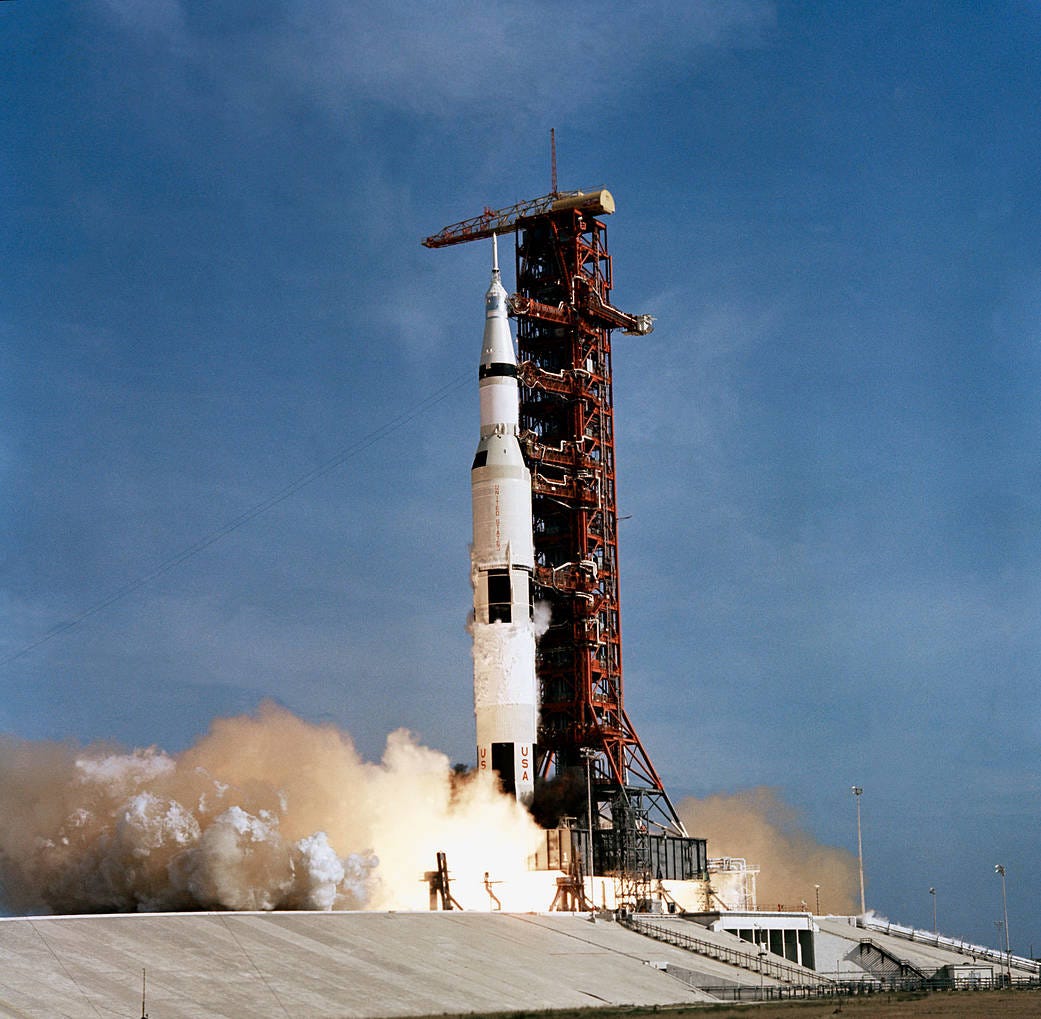
The project came about because I heard that one statement so often: We put a man on the moon, why can’t we do this as well? The Apollo program maintains a mythical status in tech policy, not only as proof that the government can do big things, but also as evidence that scientific ambition plus money equals results. Be it climate change or cancer or AI safety or semiconductor manufacturing, it is imagined that any sufficiently urgent problem can be solved if we just spend enough money and resources to moonshot it.
I went into this project just trying to understand what made Apollo successful. What came out of this was a paper that punctures the myths without diminishing the achievement. Apollo was a triumph, to be sure, but not for the reasons people usually imagine. Apollo’s success was largely due to management and oversight.
For one, I didn’t truly understand the historical context of Apollo until I started laying out all of the key dates. A little over a week separated Yuri Gagarin’s first spaceflight in April 1961 and the Bay of Pigs fiasco. These two events, a Soviet triumph and an American embarrassment, pushed President John F. Kennedy to back an ambitious space mission. Not long after, a moon landing emerged as the preferred option and by the end of May, Congress had approved the idea.
This compressed timeline got me thinking about the conditions that cause government projects to move quickly, which I take up in the final sections of the paper. It’s there that I compare Apollo to two recent programs: Operation Warp Speed (OWS), which accelerated the development of COVID vaccines, and the Broadband Equity, Access, and Deployment (BEAD) program, which funds nationwide broadband deployment. BEAD has been a boondoggle while OWS is seen as a success, and some of that is due to the speed. OWS was sketched out in mid-April 2020 and funded by May. It was meant to move quickly to address a crisis, much like Apollo. I know there’s interest in reinvigorating industrial policy, but at least for these two projects, external circumstances forced action, which is hard to replicate without a crisis.
Another major misconception about Apollo is that it was a science project. By 1961, all the pieces were in place to plan a mission to the moon. Missile programs had proven orbital mechanics, rocket propulsion, and materials science. Saturn’s massive engines were about to be delivered to NASA, following plans for a moon mission that were laid out back in 1957. There were tough engineering problems to solve, but as I wrote, all the work in the years leading up to 1961 “allowed NASA to set concrete milestones, predict resource requirements, and maintain accountability in ways that pure research projects cannot. The distinction explains why Apollo could promise a specific timeline to land on the moon before the decade was out, while true scientific breakthroughs were and remain fundamentally unpredictable.” Modern discussions about moonshots often misapply this model to projects requiring fundamental scientific breakthroughs.
Probably the most surprising thing I learned is that Apollo came exceptionally close to missing the decade deadline. By 1963, Apollo was in trouble and schedules were slipping, so much so that estimates put the earliest moon landing in 1971. So George Mueller (pronounced Miller) was brought in to manage it all. More than anyone else, Mueller made Apollo successful.
Mueller was a systems engineer who had honed his management skills in the Air Force’s missile program. Among other changes he made when he took control, Mueller implemented a program office organization within NASA’s existing institutional structure that remained throughout the Apollo program. Before Mueller, NASA’s organizational structure was functionally divided, with separate engineering divisions, manufacturing groups, and testing departments that made coordination across a complex program difficult. Mueller introduced a modern management approach that gave program offices direct authority over all aspects of their missions, cutting across the traditional functional divisions. He also streamlined operations in Project Gemini, which was established to develop spaceflight capabilities to support Apollo, and increased the pace of launches so that lessons could be learned and then applied to Apollo.
Most importantly, Mueller pushed the all-up testing approach for the Saturn V; instead of incrementally testing one stage at a time, he insisted on flying all stages together. To veteran rocketeers like Wernher von Braun, this sounded reckless. In practice, however, it was the only way to compress the timeline enough to meet Kennedy’s deadline. In effect, Mueller parallelized the problem, which is exactly what happened in OWS, as I explained:
The government backed multiple approaches, including mRNA and typical platforms, to maximize the chances that at least one would succeed. Some companies, such as Moderna and Novavax, received direct federal funding for research, clinical trials, and manufacturing scale-up, while Pfizer-BioNTech entered advance purchase agreements. In parallel, OWS poured funds into expanding manufacturing capacity by helping build production lines and secure raw materials before vaccines were approved. The US Army Corps of Engineers, for example, helped expand factory capacity. Effectively, the government paid for facilities and production expansion for vaccine candidates it might never select.
For policy wonks, the single most interesting book I read for this project was Arthur L. Slotkin’s “Doing the Impossible: George E. Mueller and the Management of NASA’s Human Spaceflight Program.” Near the beginning, Slotkin details Mueller’s overall management philosophy, which Mueller explained in a series of talks given in the late 1960s:
The criteria necessary to manage large scale R&D programs required the objective to be within the state of the art without having to reach for performance, and be achievable in a reasonable timescale. Activities required to be clearly defined for each organizational element, with engineering and design aiming for high reliability, and manufacturing providing adequate inspection and quality control. But he cautioned that reliability has to be designed into an object; it “cannot be built into a badly engineered design,” it can only be achieved by having a sound design to begin with, followed by careful manufacturing and testing. Since change is part of R&D, the design must tolerate changes. On the other hand, he warned, “we must guard against change leading to overdesign.”
The uncomfortable implication of all this is that Apollo doesn’t support many of the arguments it’s routinely used to make. Money cannot solve coordination problems. Scientific uncertainty cannot be scheduled away by political will. The government cannot replace private industry. What it shows is that we already know how to run complex technological programs but only if policymakers accept a set of unglamorous but essential requirements:
Ensure that the program’s objective is technologically possible without resorting to exceptional performance;
Rely on the ingenuity of private business;
Move quickly from proposal to contractor selection;
Convert sequential problems into parallel problems when possible;
Adopt management techniques that have been successful in similar domains; and
Implement strict planning and oversight systems.
Apollo still has a lot to teach us, and it’s not that we need to dream bigger. Rather, it’s that we need to focus more attention on better management. The full paper is here, so let me know what you think!
Until next time,
🚀 Will
Or to know how rockets actually work mathematically:
https://open.substack.com/pub/spillersideas/p/the-ideal-rocket-equation?r=1ry0si&utm_campaign=post&utm_medium=web&showWelcomeOnShare=true