

Friends, it has been way too long. The last two weeks of October I spent in Japan on my honeymoon with my wife Charlotte. I am back at work, refreshed, got much needed perspective on a number of projects I’ve been toiling on, and I’m excited about what I’ve got planned for the future.
The great distracting buzz of implication in the 2026 midterms
Some of the charm of the past consists of the quiet—the great distracting buzz of implication has stopped and we are left only with what has been fully phrased and precisely stated. And part of the melancholy of the past comes from our knowledge that the huge, unrecorded hum of implication was once there and left no trace—we feel that because it is evanescent it is especially human.
— Lionel Trilling, The Liberal Imagination (1950)
The most historic election ever. It is a cliché, I know, especially when it is repeated every election cycle. But I think there is a truth hidden in it. Elections are an interruption of the ordinary. Politics normally exists within Trilling’s great distracting buzz of implication. But for a brief moment, when votes are cast and new leaders are selected, the great hum leaves a trace.
The midterms two weeks ago were a historic mark. The Democrats had the strongest showing, for any party, in decades. Next Congress, the Dems will have at least a 255-167 majority in the House and a 55-44 caucus in the Senate, decisively shifting the power of legislative production. Propelled by weariness from high inflation and corruption in the Trump Administration, voters swung, putting Dems in power in both chambers in Congress, four new governorships, and a dozen state legislative chambers.
Data centers (DCs) were seemingly everywhere on the campaign trail. In Texas, Republican Governor Greg Abbott lost to Gina Hinojosa, who made it a central issue of her campaign. In Ohio, Sherrod Brown defeated standing Senator Jon Husted, likely because of his position on data centers. Forty-six different municipalities voted against data centers. “People really effing hate data centers,” Abdul El-Sayed said at a campaign event.
And while data centers were the center of attention for some races, the record was thin on AI policy. Ken Paxton and Josh Hawley stumped on chatbot child safety, while Abdul El-Sayed endorsed an AI policy platform in late July. But those issues didn’t move crowds like data centers. As I explain below, I think the framework of political scientist Douglas Arnold can explain why data centers did so well this cycle and also why the OpenAI–Hugging Face incident earlier this year didn’t convert into tangible legislative text. In the way that the causal chain is strong for data centers, it is weak for broader AI concerns.
Next Congress, I will be following closely to see how this develops and if the Dems are able to connect the dots. A big question for the next Congress is whether or not the energy over data centers will transfer into broader AI concerns. Let’s dive in.
What happened on election night
It might seem modest that Democrats only gained 44 seats this cycle, considering that Clinton lost 54 seats in 1994 and Obama gave up 63 seats in 2010. But that undersells the night. Sean Trende laid out the numbers in a series of posts on the House and on the Senate. Both parties have been sorting, leaving relatively few seats in the competitive middle. Republican gains in 2010 came from Republican-leaning districts that Democrats still held. Likewise, Democrats entered 2026 with fewer opportunities to flip districts. As Trende explained, weeks before the election,
There just aren’t enough seats to get to a 2010/2014/2018-type of result based on these seats. To put this in perspective, if Democrats win seats at each PVI level at the rate Republicans won Democratic seats in 2010, they would pick up about eight seats net. A rate similar to 2014 would yield four seats. A rate similar to 2018 would be much better, at 23 seats, but that’s still only about average for an out-party in a midterm election.
PVI here references the Partisan Voting Index from the Cook Political Report and it measures how strongly a district leans toward one party or the other relative to the country as a whole. Using that measure, Trende found that even a wave comparable to 2018 would produce only 23 Democratic pickups. Instead, Democrats gained 44 seats.
All combined, a slate of weak Republican candidates, strong Democratic challengers, and growing voter frustration over inflation and corruption helped fuel a sweeping shift toward Democrats. Some 99 percent of House districts moved against the president’s party this year, according to pollster Will Jordan. And if you still aren’t convinced of this round of elections, when exactly was the last time that the median district was moved 14 points?
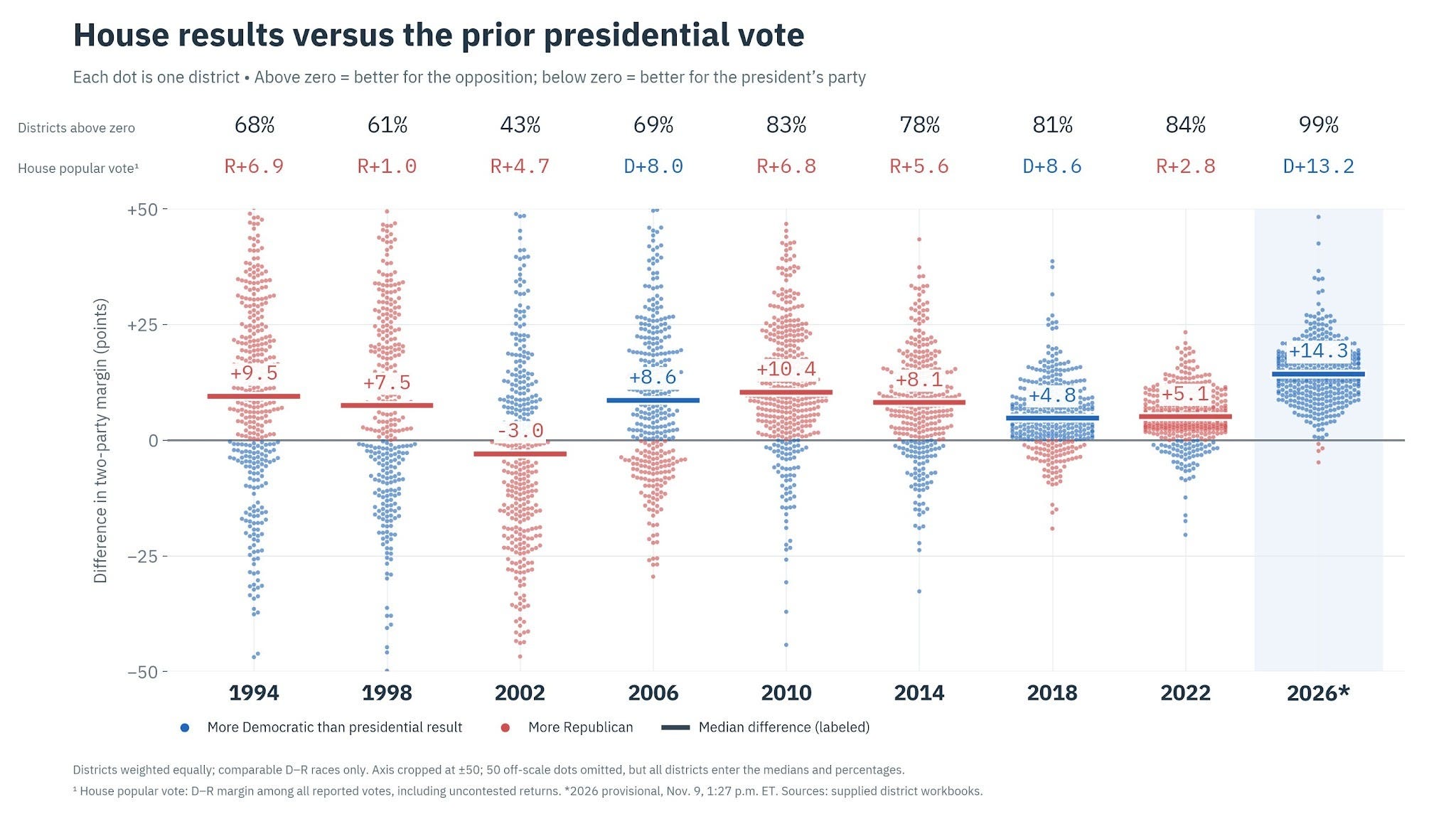
This movement away from Republicans was driven by the economy (39%) and the state of democracy (33%), according to the Associated Press’ exit poll. Then came immigration (14%); healthcare (8%); foreign policy (4%); and crime (3%). In other words, the rise in prices and corruption in the Trump Administration pushed voters, even those who traditionally vote for Republicans, against Trump’s slate of candidates.
In a number of key races, data centers became the dividing issue, which is not surprising, because they gave candidates a way to connect national economic grievances to local races.
In Texas this cycle, previous support of data centers became a political liability. In August, then-Governor Greg Abbott issued an executive order addressing data centers. It was an about-face for a governor who had cheered on data center development in the state, calling Texas the “epicenter” of the buildout months earlier. The move was clearly meant to blunt Democrat Gina Hinojosa’s attacks on the issue, but it was not enough to get him reelected. Hinojosa, now the governor-elect, made data centers a prominent part of her campaign and has already promised data center laws. The issue also resonated farther down the ballot. As the Associated Press reported, Clayton Tucker became the first Democrat elected agriculture commissioner since 1986, a victory he attributed in part to his opposition to data center development.
Texas wasn’t the only place where data centers seemed to shift voters. In Ohio, Sherrod Brown defeated standing Senator Jon Husted by going after his record of supporting data center buildouts. In August, the National Republican Senatorial Committee (NRSC) warned that the issue could help the Democrats flip the seat, admitting that “more than any other thing in this race, data centers are the anchor hanging around Husted’s neck.” Husted countered with a Ratepayer Protection Act but Ohio Democrats pummeled him with nearly $28 million spent on data center ads.
David Crowley, the next Wisconsin Governor and a Democrat, changed his position on data centers under pressure from a Republican opponent. Initially opposed to any moratorium, Crowley later said he supported one and then went on to suggest abolishing the state’s sales tax exemption for data center operators and developers. Meanwhile, Vivek Ramaswamy pledged a day-one executive order halting new data center approvals, Mike Rogers endorsed a one-year moratorium and Stacy Garrity called for a pause. All of them lost.
Voters came out against data centers, rejecting them in 46 out of 47 midterm policy measures. I’ve mapped the results below, and the geographic concentration is notable. The Midwest was where most of the action happened; Ohio itself was responsible for 21 of them.
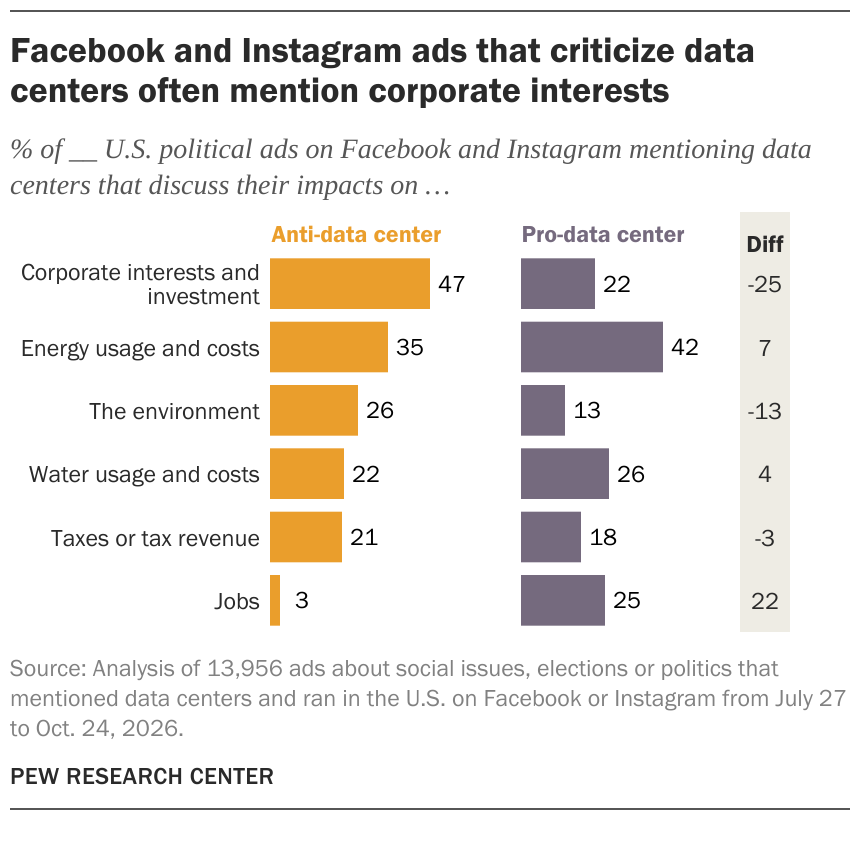
Data centers were a big issue in the Midwest and the Rust Belt. Ohio, Michigan, Wisconsin and Pennsylvania, all battleground states, got over half of all the TV ad spending on data centers. According to one estimate, at least $380 million was spent on political television ads mentioning data centers. Though, to be fair, the entire election cycle was expected to reach $11.6 billion this year. Still, candidates found a winning formula by connecting incumbents’ support of DCs to high utility rates, votes for tax breaks, and their role in stressing water resources. Pew’s analysis of Facebook and Instagram ads, which is clipped below, supports this thesis. Abstract AI policy like frontier safety rarely made it into ads.
This election also showed, yet again, that moneyed interests cannot simply purchase electoral outcomes, a point I think is too often lost. Elon Musk spent nearly $500 million this cycle to defend Republican control of Congress and rescue Ken Paxton. Both lost.
Consider what happened with Alex Bores. Leading the Future, a super PAC backed by AI executives and investors, put $10 million into a campaign to oppose Alex Bores in New York’s 12th Congressional District primary. Bores, one of the architects of New York state’s RAISE Act, lost to Micah Lasher. But that didn’t really matter much for policy because Lasher was a co-sponsor of the RAISE Act and supported a moratorium on data center development. Simultaneously, groups aligned with the AI safety camp spent roughly $19 million supporting Bores, turning a primary into a proxy war over AI regulation. Bores had been polling in the single digits before the outside spending elevated his profile. It was a classic Streisand effect.
How much did any of this actually matter to voters?
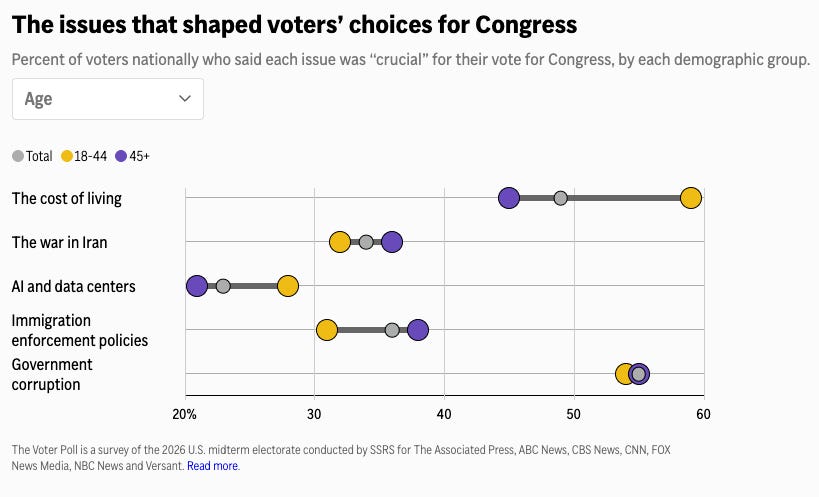
According to NBC’s analysis of the Associated Press Voter Poll, 56 percent of voters said AI and data centers were a “crucial or major factor” in their vote for Congress. That number feels large but it needs context. Importantly, the survey asked respondents to rate the importance of several issues, rather than rank them. And even when rated, AI and data centers were behind every other issue tested, captured in the chart below. I will also say that I have never been a fan of polls that combine AI and data centers. Voters understand the difference and they really dislike data centers.
Pew polling from early October confirmed the status of AI as a political priority. Artificial intelligence ranked 11th among 16 issues, with 44 percent calling it very important, compared with 84 percent for the economy. AI matters to voters more than climate policy and issues around race and ethnicity, but it remains well behind the issues that traditionally dominate elections, like the economy, corruption, healthcare and education.
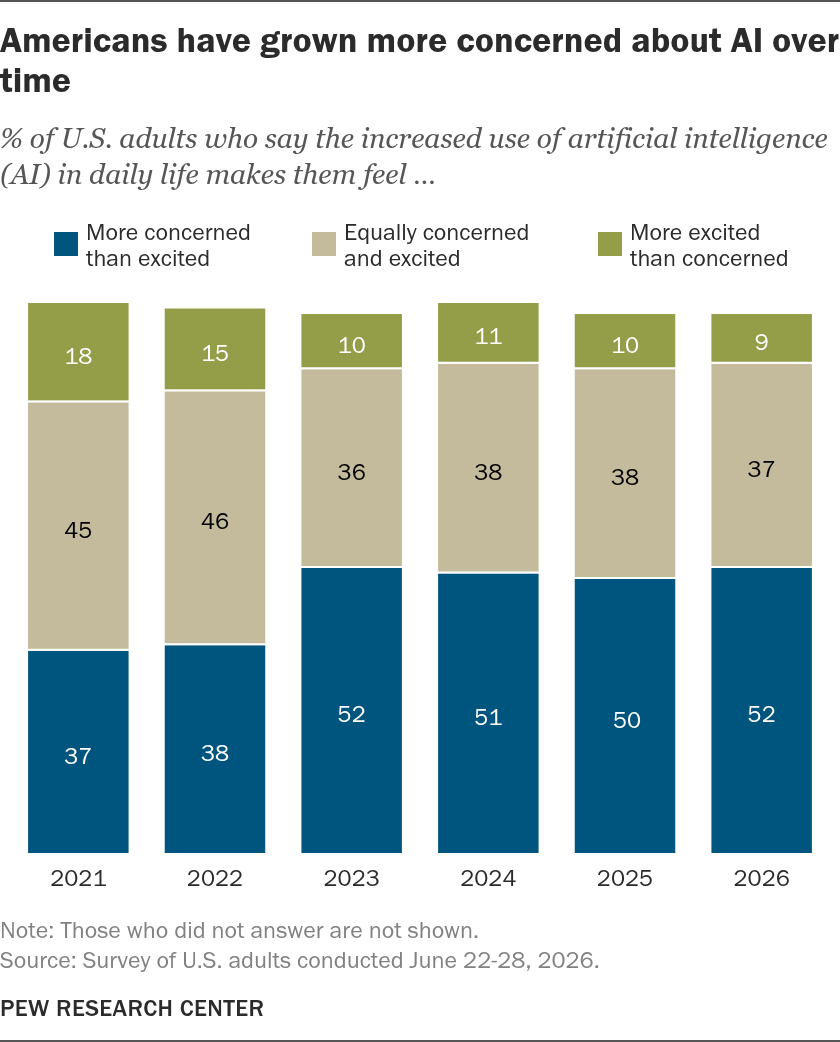
And yet, Pew’s polling on AI also shows that opinion has been relatively stable since 2023. Honestly, I was a little surprised when looking into it. About half of all people are now more concerned than excited about AI, and that hasn’t changed all that much. What has changed is the intensity of specific concerns.
As Justin Hendrix documented in Tech Policy Press, the public has gotten far more comfortable in supporting a slowdown in AI. In early 2026, a Fox News poll found that 59 percent of registered voters thought that the US was moving too quickly on AI. By early October, a poll from The Economist and YouGov put that at 71 percent of registered voters. The public also seemingly embraces safety requirements for AI. A September Quinnipiac poll found that 86 percent supported independent safety standards even if they meant that AI development slowed. And a September poll from the AP and NORC found that 8 in 10 U.S. adults say it’s important for the U.S. government to ensure that AI stays under human control.
At the same time, there isn’t much trust in government to act. Just 31 percent of Americans trust their government to regulate AI responsibly, according to the Ipsos data from Stanford’s 2026 AI Index. Notably, this trust was the lowest share among countries surveyed. And similarly, that September AP-NORC poll found that 39 percent trusted neither political party to handle AI.
Speaking to the split in power between federal and state authorities, a NetChoice/Echelon survey found 68 percent preferred national AI rules applicable in every state. But when the AI Policy Institute offered respondents several approaches to state authority in June 2026, half preferred allowing states to regulate AI until Congress established federal rules, while only 16 percent favored preventing states from acting altogether.
What this tells me is that Americans want national consistency and meaningful regulatory safeguards but they haven’t really settled on how to balance the two. That still leaves a lot of flexibility to Congressional leaders weighing a vote on AI. Especially with something moving as quickly as AI, they will have to think a step ahead and imagine what might make that choice matter to voters by the next election. Expectations of the future help to guide current policy.
The politics of potential preferences
The fact that most voters aren’t well informed about politics presents an interesting question for democratic representation. Voters often cannot name their representatives and far fewer can tell you what the legislature did last session, so why do politicians act as if public opinion constrains them?
In 1961, political scientist V.O. Key argued in Public Opinion and American Democracy, a classic in the literature, that elected officials respond to the opinion that could exist, not the opinion that does exist. Legislators aren’t just thinking about the people that call them or come into their office, they also imagine how a vote will look if the issue becomes important before the next election. Douglas Arnold built on this insight in The Logic of Congressional Action to understand why lawmakers pass specific policies and how they balance competing interests among groups. I think his framework is especially helpful to understand what’s happening in AI and data center politics.
Arnold splits “the public” into two groups, attentive publics and inattentive publics. Trade associations, labor unions, and the like already have strong opinions and are attentive to actions by Congress. Attentive publics are a well-worn topic. But how are inattentive publics activated? This group doesn’t have active preferences right now but might be pushed into action under the right circumstances. Both Key and Arnold are correct to assume that, when legislators are voting, they are estimating those potential preferences and weighing them alongside the demands of the people already at the table. The expectation of future political action can be a constraint today.
For Arnold, two conditions determine whether a dormant public wakes up. First, someone has to raise the issue. There needs to be an instigator to make the issue salient, which could come in the form of a primary challenger, or an interest group, or even through the reporting of a journalist.
The second condition is what Arnold calls traceability. For an issue to activate these inattentive publics, citizens need to be able to “plausibly trace an observed effect first back to a governmental action and then back to a representative’s individual contribution.”
Continuing, he wrote that, “traceability requires the existence of three conditions: a perceptible effect, an identifiable governmental action, and a legislator’s visible contribution. If all three conditions hold, the prospects for citizens using the incumbent performance rule are good. Lacking even one of the conditions for traceability, this form of retrospective voting becomes virtually impossible.” In other words, voters can only punish an official if they can follow a chain from an effect to a government action that caused it and then back to the official’s role in that action.
But traceability also helps to explain why politicians will bundle unpopular provisions into large bills, rely on procedural votes, hand decisions to agencies, and push effects years into the future. Each of these tactics adds deniability, which in turn weakens a link in the chain. The figure below comes from Arnold’s book and helps to visualize the process.
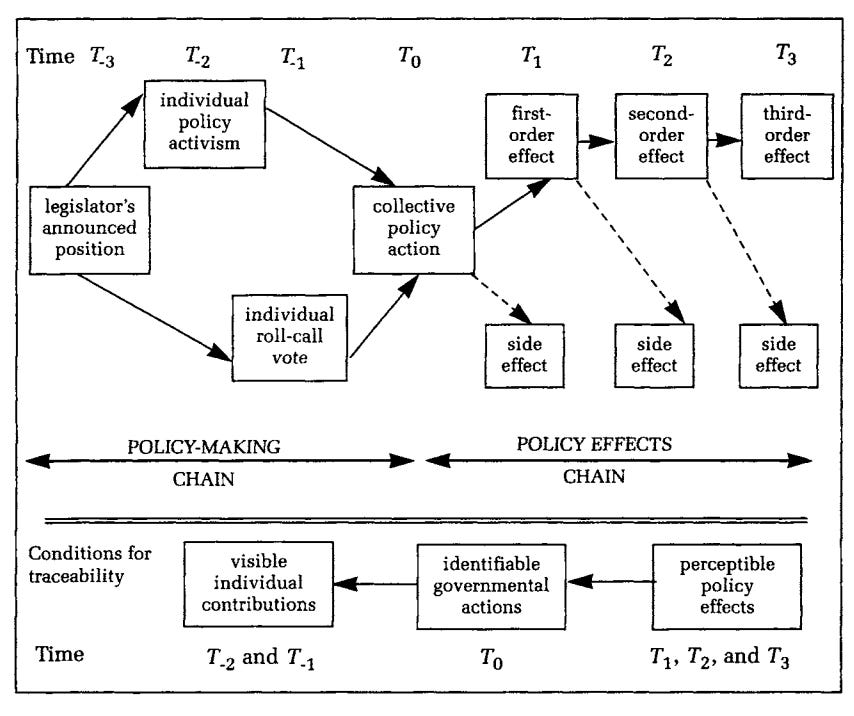
While every model is imperfect, I think Arnold’s helps to explain why AI and data centers are diverging as political issues.
For data centers, the links in the causal chain are strong. For one, the effects are perceptible. It is quite noticeable when hundreds of acres become a massive construction project. And since this infrastructure requires energy, it is not a stretch that a new data center might have a role in driving up electricity bills. Second, there are clearly identifiable government actions. They require zoning approvals and utility commission rulings, so government action is also easy to pinpoint. And working back from here, the individual contributions by a politician are visible. A county board member has to cast a vote for the project.
But Arnold’s model also helps explain the political logic behind New York and Texas’s change in data center policy this summer.
In June, the New York state legislature passed a bill that imposed a one-year moratorium on permits for new data centers. On top of this, the bill directed the Public Service Commission to create new electric and water rate classes for large data centers. Notably, Governor Hochul never signed it. Instead, she issued Executive Order No. 62, which imposed a narrower pause on new development until the Department of Public Service completes an environmental review. Projects can move forward, provided they secure the necessary state and local approvals, once the state establishes its standards.
Not long after, Texas Governor Greg Abbott did something similar. On August 3, he directed the Public Utility Commission and ERCOT to suspend data center interconnection requests while they conducted an audit. As a part of this review, data centers will have to disclose their water consumption, tax incentives, cooling technologies, and ownership structures.
It’s notable that both a Democratic governor in a blue state and a Republican governor in a red state arrived at essentially the same political solution. But it makes sense when thinking about traceability.
A moratorium is a highly visible political act that lets the governor claim a win. But the tough decisions over defining the rate classes, the standards for inclusion, the technical standards, and how to allocate costs among groups all get handed to a utility commission where they can get worked out. Besides, who will be following these slow, arcane regulatory rulings, other than policy nerds like myself?
Rate-class reforms tackle the first link in the chain. If data centers are forced to pay for their own grid upgrades or bring their own power, then the causal link between residential electricity rates and data centers gets harder to connect. So, I expect more decisions about data centers will get handed to public utility commissions and more state moratoriums will be announced, letting legislators claim action without killing projects outright.
Unlike data centers, however, AI policy has weak traceability. Data centers can be easily spotted, AI safety cannot. Even now, even though countless regulations apply to AI, people think AI is unregulated. And when something goes wrong, was the company to blame or was government for not regulating the tech?
What might change this?
My bet would be job loss. Voters already expect AI to disrupt the labor market. A Reuters/Ipsos poll in June, for example, found that 53 percent of Americans worried AI could cost them or someone in their household a job. And Quinnipiac found that 30 percent of employed Americans worried their own jobs might become obsolete, up from 21 percent in April 2025. Company announcements increasingly point to AI as a reason for restructuring, even though the labor market has yet to show a corresponding wave of unemployment. But in announcing that AI is the cause for cuts, these companies are strengthening the first link in the chain, a perceptible effect. I suspect that Dems in the new Congress will attempt to connect the rest of the dots.
Traceability also helps to explain why AI preemption failed 99-1 last year in the Senate. When it was first proposed, voters’ preferences were still fluid. Over the next several weeks, opposition congealed around specific protections that states might lose. By the time the Senate voted, even a senator whose constituents had barely followed the debate could picture how that would play in the next campaign. Voting to strip the moratorium was the safer choice. That logic will also be in play next year. An AI bill will be judged by protections that voters can easily name.
What to expect next Congress
Next Congress, Democrats will have at least a 255-167 majority in the House and a 55-44 caucus in the Senate. And as Reuters reported, “Democrats are planning to unleash a flood of new legislation targeting artificial intelligence systems and data-center development when they take control of the US Congress in January.” Still, how Dems use these majorities will largely depend on who comes to lead the committees.
In the House, the Energy and Commerce Committee (E&C) and the Science Committee are likely to be the key sources of legislation. The E&C’s authority means it will be the lead committee for AI regulation, while the Science Committee oversees NIST and technical standards, which could become important depending on the nature of the AI bill. It is largely expected that Frank Pallone will take over House Energy and Commerce, while Zoe Lofgren is seeking the chairmanship of the House Science Committee. And Zoe Lofgren has said that Dems need to focus on developing “responsible regulations for AI while also fostering innovation.”
In a sign of what is likely to come, Pallone and Lofgren joined with Jamie Raskin, the top Democrat on the Judiciary Committee, to send letters to five leading frontier AI companies, “requesting information and ongoing reporting to Congress about AI model misalignment and safety incidents within 48 hours of incident detection.” It was clearly a preview of how Democrats will use their expanded oversight.
Notably, Senators Elizabeth Warren and Richard Blumenthal have already opened an investigation into the Trump administration’s secret frontier model framework, which I detailed back in July. On November 2, the Washington Post reported that the government had identified 60 pages of documents but refused to release them, citing national security concerns. I suspect that the new Congress will push to uncover all of the accompanying documents surrounding the secret framework. I also imagine there will be an effort to gain access to the unpublished evaluations from the Center for Advancing Innovation and Standards for Super Intelligence (CAISSI); details about the Pentagon’s contract dispute with Anthropic; how Commerce Secretary Howard Lutnick has been licensing AI chips for export; and specifics about Commerce’s export restrictions on Anthropic’s Mythos 5 and Fable 5 models. Bloomberg reports that Nvidia will be an early target.
On the Senate side, Maria Cantwell is positioned to replace Ted Cruz as chair of the Commerce Committee. Just before the election, Cantwell published a six-principle framework for frontier AI governance, calling for enforceable federal safety standards, continuous testing, reporting of serious failures, and independent audits before covered models are released. It also includes worker protections and human oversight of consequential decisions, all of which could become negotiating points for an AI bill. Senator Cantwell has long been considered the holdout for privacy legislation so she might block a deal she considers too weak. Indeed, she criticized an AI bill being championed by Senators Cruz, Klobuchar, and Thune, saying that the “answer is not a weak federal standard.”
There is also growing interest in giving AI a more permanent institutional home in Congress. Hakeem Jeffries established a House Democratic Commission on AI and the Innovation Economy in 2025, while Senator Ruben Gallego introduced a resolution in September 2026 to create a Senate Select Committee on Artificial Intelligence. Both reflect a growing recognition that AI policy cuts across traditional committee jurisdictions.
Because so many candidates won on the issue, data centers will dominate the agenda in the first half of the next Congress. Senator Chuck Schumer named data centers as a top priority, as did Representative Hakeem Jeffries, the presumed leaders of the Senate and the House.
Senator Martin Heinrich, the top Democrat on Senate Energy, released a cost-allocation bill a couple of weeks back that “require large load customers like data centers to pay for the facilities needed to connect them to the grid, not to consider it, not to make pledges, to actually do it.” He said it would be a top priority should he become chair next year. However, according to his own press release announcing the bill, Heinrich also “argued some Democrats are going too far in trying to stop data center development by imposing or threatening moratoriums, which he said could lead development to go to places with little to no rules governing their expansion.” The Democrats could split over this issue, given that Senator-elect Annie Andrews of South Carolina is not the only one supportive of data center moratoriums.
The locus of policy making in Congress has shifted and so too has the starting position for AI. Preemption has been a core organizing principle in the federal Republican coalition for decades. What replaces it is far from settled. Will Democrats begin with frontier model safety and build around it, or perhaps begin with privacy legislation and expand it to AI?
According to reports, Representative Lori Trahan is working on a standalone bill to mandate independent safety evaluations and impose liability for AI companies, splitting from her bipartisan bill with Jay Obernolte. It could be an important vehicle. Meanwhile, in the Senate, Mark Warner’s Secure AI Development Act would require secure testing of the most advanced models and give the National Security Agency access to qualifying models before release.
There are any number of legislative approaches that could be taken, which makes the coming decisions over committee chairs and subcommittee leadership consequential. Leadership in the committees and in the chambers will help determine which bills receive attention and ultimately which bills have a chance of reaching the floor. But Democrats will still face a Republican president, the Senate’s legislative constraints, disagreements within the coalition, and a limited shot clock.
Some final comments
So what do I think of all this?
First off, data centers were probably a flash in the pan for the 2026 midterms, driving campaigns against incumbents who supported DCs. But once this realignment is finished, I’m not sure the same juice will be there for campaigning in 2028.
But that doesn’t mean the next Congress won’t see a flurry of bills on DCs covering electricity costs, grid interconnection, water use, and transparency. The much more interesting question for me is how the Democratic coalition will deal with calls from progressives to stop all data center development. If progressives take spots in critical committees that regulate DCs, it would make passage far more difficult.
And as much as I don’t want it to happen, I fear that a massive AI-enabled cybersecurity incident or a really bad jobs report will drive Congress to act. Already we are seeing flickerings of this when banks were down Monday and when air traffic control was shut down last week. Crises are never good for policy and they could encourage Congress to reach for whatever proposal is most easily explained in a traceability sense, rather than the policy that best fits the underlying problem.
Thankfully, there has been an ongoing and robust conversation about standards that can be enforced, evaluations, how lines of responsibility should be split for deployers and developers, and ways to protect citizens from harm. But I am also reminded of how the House of Representatives voted 352-65 against TikTok after the company sent a mass notification to its users to call their members of Congress and oppose the bill. Opinion on the Hill moved quickly against TikTok when it became clear they were exercising political power. It helped turn concern about the platform into anger about its influence.
Elections leave traces, which the 120th Congress will have to sort. The Democrats took back control of Congress, in part because of the animosity towards data centers. But it remains an open question whether they can convert this into legislative action. The midterms are over, bringing back the great distracting buzz of implication.
Until next time,
🚀 Will