

Last week, I had an op-ed run in the Washington Post about the darker turn in technology politics. (My X thread is here.) Recently, a Molotov cocktail was thrown at Sam Altman’s home. Shots were fired at the home of an Indianapolis city council member who supported a data center project. Autonomous taxis have been vandalized by angry crowds. Most people worried about AI, data centers, or automation are not violent. But the incidents are warning signs.
In moments of rapid technological change, some people do not simply resist the future. They try to terrorize it.
Part of the op-ed explores the history of Luddites. The original Luddites were not simple machine-haters. They turned to sabotage because ordinary political and economic channels had been closed off. Wage negotiation had effectively been outlawed, leaving workers without a lawful way to contest the terms of technological change. The lesson is not that sabotage was justified. The lesson is that technological disruption becomes more dangerous when people believe they have no legitimate way to shape it.
But Americans have political channels that the Luddites lacked. Citizens can use legislatures, courts, agencies, state governments, federal oversight, public comment, and elections to contest how new technologies are deployed. Senator Bernie Sanders is wrong to claim that AI is “completely unregulated.” However, he captures a common sentiment that government is doing nothing on AI.
This is partly why I built AI Policy Hub, a new website you can find at PolicyHub.us.
The site started off as a collection of all the executive and agency actions. The list now covers over 200 executive orders, memoranda, and policy documents across the two Trump administrations, the Biden administration, as well as individual actions by various agencies. Send me missing items. I am sure there are plenty.
The goal is to make AI policy more transparent. So, I have worked on compiling the basics and making it all available to researchers.
One key element is a python script that queries Legiscan’s API for state and federal AI bills. Every Monday morning, the site runs the script to find every state bill that mentions artificial intelligence, machine learning, algorithm, automated decision, facial recognition, generative AI, large language model, or deepfake, and then dumps the csv files into my data folder, triggering a rebuild of the website. I have never worked with Github Actions but learning the process was incredibly satisfying. When I have finished my initial analysis of AI bills, I’m going to rewrite the code to make it cleaner and then plug the pipeline into Claude for analysis. Once this happens, I’ll update the link above so that others have a strong structured JSON prompt for bill analysis.
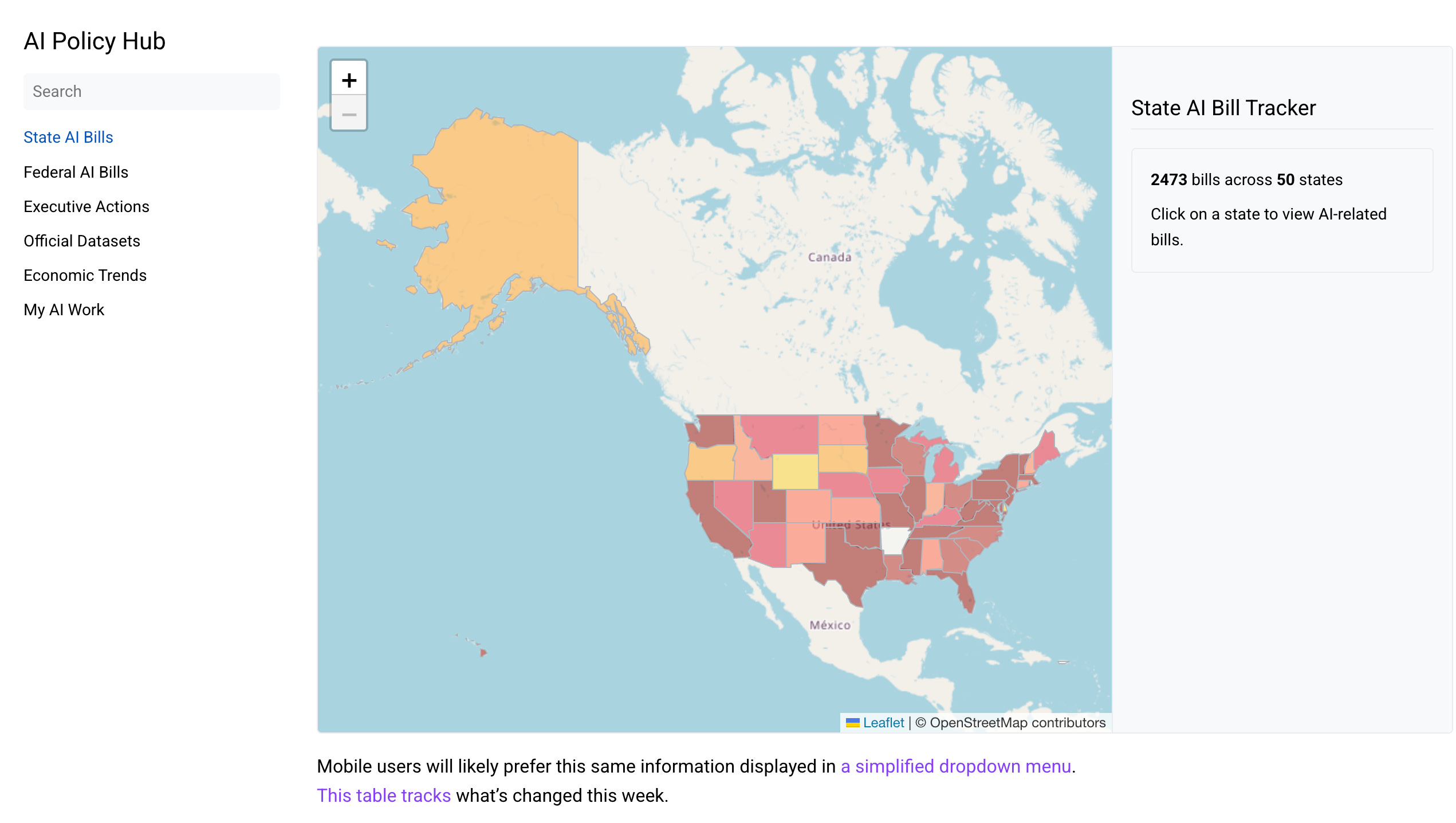
These two datasets power two key pages, the State AI Bill Tracker Map and the Federal AI Bill Tracker.
The State AI Bill Tracker Map is an interactive map of AI bills in the states. It provides a visual overview of where state-level AI legislation is concentrated and lets users drill into individual bills by state. You can access the same information through a simplified dropdown menu. I also wrote a script that updates this table every week with what’s changed.
The Federal AI Bill Tracker is a searchable, sortable table of AI-related bills introduced in the U.S. Congress. Each entry includes the bill number, title, current status, last action date, committee assignment, sponsors, and a short description. Users can filter by committee to narrow results. The tracker covers both the House and Senate and updates as bills move through the legislative process.
AI Policy Hub also features a curated dashboard of FRED charts tracking the economic indicators that are most relevant to AI’s impact. There are seven categories:
employment trends (information sector, software publishers, computer systems design, data processing/hosting);
wages and compensation;
productivity (software publishers, computer/electronics manufacturing, total factor productivity);
investment and capital formation (IT equipment, software, computers, communications equipment);
industry output;
labor market dynamics (JOLTS openings, Indeed job postings for software development and IT operations); and
regional tech hub employment in Silicon Valley, Seattle, and Austin.
Each chart includes a short explanation of what the series measures and why it matters, all in a card that I designed.
Two other pages round out the site for now.
The Economic Trends page is a reprint of my congressional testimony, reviewing the empirical research on AI’s economic effects. This piece explains how AI fits the pattern of general-purpose technologies, how AI changes tasks and skills (with detailed discussion of specific studies on customer support, coding, legal work, writing, and neurodivergent workers), how companies are adopting AI (drawing on Census BTOS data and enterprise surveys), the gap between AI experimentation and measurable profitability (”jagged adoption”), and early labor market effects on entry-level workers. At the end is my table of empirical AI research that I’ve been collecting.
The last page for now is a narrative description of all my AI work.
The site is written in Hugo markdown, so while it renders fast on both mobile and desktop, I’m still working on the mobile experience. Neither the FRED charts nor the state AI map renders the way I want on mobile, so I’m going to play around with it. I also intend to build out some other key pages. I know there are gaps in court cases, current laws, polling, and outside research. I also want to build out an FAQ for data centers and redo the economic trends page. However, I see this site as a work in progress and something to build up over the coming months.
As always, let me know what you think!
Until next time,
🚀 Will
Excellent project. Kudos!
this is fantastic dude. would you be interested in having us republish it on The Renovator? i think this tool you created is super pragmatic and valuable